The Great Learning 大學 — Three Goals and One (Right) Order
Don't we, in our modern society, all too often chase after facts while the foundation at home, or within ourselves, is faltering? Centuries ago, the Chinese philosopher Confucius already offered the perfect guide to getting your priorities back in order: the Daxue.
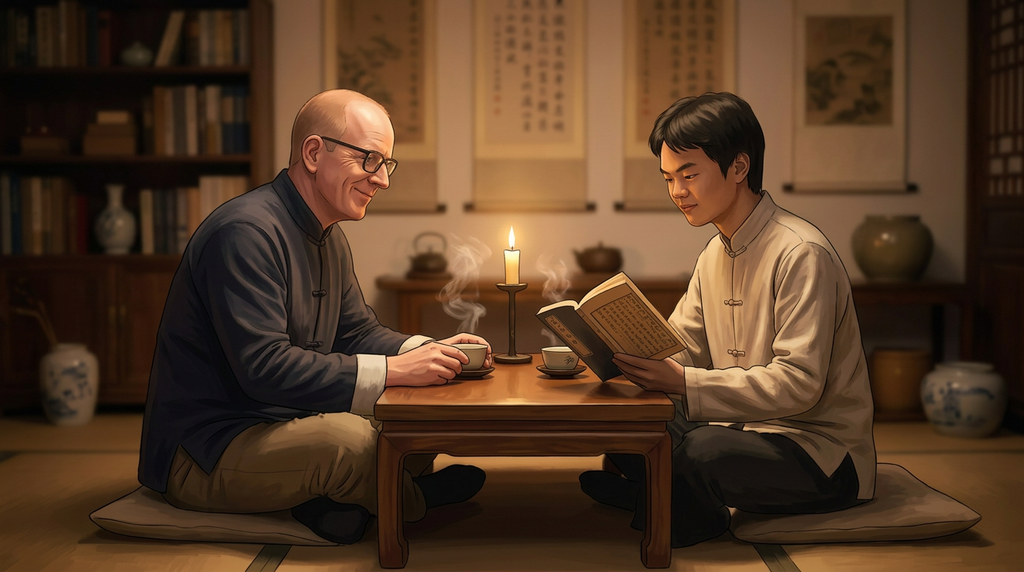
Perhaps you know the feeling: people around you who simply understand you, without needing many words. On a spiritual level too. Near or far away — it doesn't matter, because the Dao connects and transcends every distance. Recently I put a question to a fellow practitioner: “Shall we study the Daxue together?” We had already immersed ourselves in the Diamond Sutra before this. The answer was clear: “Sure!” The seed was planted!
A prerequisite among the people who study this text is that you are honest and dare to make yourself vulnerable. Both the pleasant and the less pleasant sides of yourself come to the surface. You run up against things, and step by step you learn to recognize your own faults.
The Daxue (大學), the "Great Learning". A text of barely a few pages, for centuries required reading for every Chinese scholar. It is not a mysterious text, it´s simply a very practical manual about a right order.
The origin: from a single chapter to a philosophical cornerstone
Originally, the Daxue was not a standalone book, but a specific chapter within the Liji (禮記), the classic Book of Rites. The text is traditionally attributed to Confucius and his influential disciple Zengzi (曾子).
Only centuries later, during the Song dynasty, did the work gain its current prominent status. The great Neo-Confucian scholar Zhu Xi (朱熹) lifted the Daxue (大學) — literally translated as "The Great Learning" or "Learning for Adults" — out of the Liji and crowned it as one of the Four Books. Together with the Analects (Lunyu 論語), the Book of Mencius and the Doctrine of the Mean, the Daxue from that moment on formed the absolute foundation of the Chinese education system and the imperial examination system. Zhu Xi saw this short but powerful text as the perfect gateway and manual for anyone who wants to begin with self-cultivation.
The text opens with one line that contains the entire programme:
大學之道,在明明德,在親民,在止於至善。
The way of the Great Learning: to let the radiant within you shine forth, to renew the people, and to rest in the highest good.
Translated plainly: find your true self again, radiant, free of earthly desires. Show it by sharing, everything. And hold on to this; do not fall back into "the old ways".
When we give things away in everyday life, people often say: "but wait, don't you need that yourself? Surely you're not going to give that away?" Or: "I'd like to pay you for it!" I usually reply: "whoever cannot share cannot multiply either." In other words, if you keep everything for yourself, you become selfish and begrudge others what they need. In the end, people may simply stop liking you.
Anyway: there are three goals. You could call them the three goals of every adult, wherever they may live. Let's take a look.
Goal 1: Letting shine what is already there
明明德 (míng míngdé) — literally: 'to enlighten the illustrious virtue'. Note the double míng 明. The first is a verb (to make shine), the second míngdé 明德 means 'illustrious, bright'. This word míngdé 明德 forms a single entity and cannot be used separately.
The underlying idea is optimistic. Confucianism does not say: you are broken and need to be saved. It says: something bright is already present in you, from the very beginning. Like a mirror. It just gets dirty, covered in dust. Ego, habit, haste, the opinions of others, the invisible mask you wear to be liked and so on (at the office, at parties, you name it).
Task number one: add absolutely nothing more — start cleaning.
In Buddhism this is called finding your Buddha-nature again. Zhu Xi, the great commentator of the twelfth century, said it in a single line: it is not about creating something new, but about letting the light you already have shine again.
Goal 2: Renew, learn and share
親民 — to renew the people. (The text plays here with 親 "close to" and 新 "new"; traditionally it is read as "renew".)
This is the social turn and it may well be the most beautiful of the three. Self-cultivation is not a final destination. As your inner clarity grows, it shines outward of its own accord. You start helping others polish their own mirror. Whoever reaches the mountaintop and stays there enjoying the view has walked only half the path. But watch out: the moment your self-cultivation suddenly lets you see someone else's faults and you begin to despise them for it, you miss the point entirely. Then there is work to do: telling your ego to keep quiet.
Goal 3: Staying, not falling back
止於至善 — to rest in the highest good. That word zhǐ (止) means "to stop, to dwell". Not: striving on forever. But: coming home to the place you no longer need to go beyond.
Remember that last line from the plain translation above? "And hold on to this; do not fall back into 'the old ways'." That is exactly this step. Shining for a moment is not so hard — a good conversation, an inspiring morning, a moment of insight. The art is: living there. Holding on to it. Not shining for a moment and then putting the office mask back on as if nothing happened. What matters is that you find the radiant within yourself, and keep it.
In a culture and society of endless more, more, more, this is a nearly radical idea. Maturity is not wanting more. It is knowing where enough is and not letting go of it.
Why is stopping, coming to rest (止), so powerful?
「知止而后有定;定而后能靜;靜而后能安;安而后能慮;慮而后能得。」
Only when you know where to stop does steadfastness arise. From steadfastness comes inner calm. That calm brings serenity. Serenity leads to deep reflection. And from that deep reflection you attain wisdom (or the result).
This process unfolds in five clear steps:
- Step 1: From knowing your limits to steadfastness (止 → 定)
- Step 2: From steadfastness to inner calm (定 → 靜)
- Step 3: From inner calm to serenity (靜 → 安)
- Step 4: From serenity to deep reflection (安 → 慮)
- Step 5: From deep reflection to the result (慮 → 得)
The text shows here that you can only make truly wise decisions or reach your goal (得) when you start by setting boundaries and knowing where to stop (知止). Everything in between is the process of calming your own mirror, step by step.
And then: the order
A few lines further on comes the sentence that sums up this entire text:
物有本末,事有终始。知所先后,则近道矣。
Things have roots and branches, affairs have an end and a beginning. Knowing what comes first and what follows — then you are close to the Way.
Roots first, branches later. Whoever prunes branches while the roots are rotting ends up with a beautiful tree that topples in the first storm.
And notice a clever detail: the text doesn't say "beginning and end" but 終始 — end and beginning, in that order. In classical Chinese that's no accident; everything there moves in cycles. The end of one thing (like winter) is always the seed of the new beginning (spring). But it also invites you to first think about where you want to end up, and from there reason back to today. Begin with the end in mind. Twenty-six centuries before the management books invented it. So you already had one — a study guide for life — and it was free.
The eight steps
The Daxue then sums up the whole path in eight short steps, each one a condition for the next:
- Géwù (格物) — Investigating things — Studying reality and its principles to gather objective knowledge.
- Zhì zhī (致知) — Extending knowledge — Deepening your own insight and wisdom based on your observations.
- Chéng yì (誠意) — Making the intentions sincere — Being honest with yourself, without self-deception, so that your motives are pure.
- Zhèng xīn (正心) — Rectifying the heart — Bringing your emotions into balance and purifying the heart of prejudices.
- Xiū shēn (修身) — Cultivating your own person — The foundational step: physical and moral self-improvement in daily life.
- Qí jiā (齊家) — Regulating the family — Bringing harmony, respect and order into your own family and household.
- Zhì guó (治國) — Governing the state — Applying moral leadership to bring justice and order to society.
- Píng tiānxià (平天下) — Bringing peace to the world — The ultimate goal: worldwide harmony and well-being for everyone.
The conclusion
From the emperor to the common man: everything rests on self-cultivation as the root.
(自天子以至于庶人,壹是皆以修身为本。)
There it is again, that root. From the emperor to the common man — no one stands above the order. How often do we commit ourselves to the outside world while our own house is not in order? Branches, all of them branches. Water the root first. During our conversations it is simply obvious: the moment one of us is honest about his own faults, the other automatically becomes more vulnerable too. That is 修身 and 親民 in a single conversation. (修身 Xiūshēn — self-cultivation / self-improvement | 親民 Qīnmín — renewing the people / staying close to the people).
Last but not least
What I find so beautiful about these old texts: they ask nothing impossible. No mountain to meditate on alone, no monastery, no separate reality. Only an order. First polish the mirror, then enter the world. First know where you want to rest, then begin.
And as the text itself says: whoever knows the right order is already close to the Way 道 (Tao).
Notes:
[1] The Daxue 大學 was originally a chapter of the Liji (禮記, the Book of Rites). Zhu Xi (1130–1200) turned it into a standalone text and placed it at the head of the Four Books. The two quoted lines stand in the core chapter (經), traditionally the words of Confucius himself, recorded by his disciple Zengzi.
[2] A reading tip for those who want more: the Daxue 大學 is short and available in good English translations. Read it in one sitting — it is a text for one sitting, with a load for a lifetime. You can also visit www.fourbooks.org — a wonderful site with a companion mobile app, free of ads. I unlocked the ´scholar package´ myself for a few euros. You then get all the explanations and translations (highly recommended!).
[3] On the Three Teachings (Sanjiao): Although the Daxue is a purely Confucian foundational text (focused on ethics and social harmony), Zhu Xi's Neo-Confucian interpretation (12th century) reflects the dynamic of the Three Teachings. Zhu Xi and other scholars of his time drew deep inspiration from the psychology of Buddhism and the cosmology of Taoism to give the Confucian texts a deeper spiritual and meditative layer. This explains why concepts such as the 'originally clear mirror' feel so recognizably Buddhist.