How I came to know Confucius
Confucius: nothing happens by Itself – My journey of discovery.
If you grow up in the West, without direct ties to Eastern cultures, you might know Confucius as a name—but not as a life philosophy. That was the case for me, until I came into contact with his wisdom through an unexpected path.
My wife is of Asian descent, but when we first met, around 1989, we were mainly focused on settling down: a job, a house, responsibilities. Religion or philosophy weren’t high on our agenda. That changed when health issues led me to a Taiwanese acupuncturist. One thing led to another, and we became friends with people who grew up with Buddhism, Taoism, and Confucianism.
What struck me most was the warmth and solidarity within that group. As a Westerner, I had to adjust to it at first—but soon, it felt familiar, and the friendships only grew stronger. It feels as if we are family.
Even when we travel to Taiwan, there are always people ready to welcome us with love. No pressure, no obligations, no expectations—just from the heart, out of compassion.
Over time, I began to explore the Three Teachings: Confucianism, Taoism, and Buddhism. You learn to see the extraordinary in the small things again. It brings peace and stability to the mind.
Who Was Confucius?
Confucius (551–479 BCE) was born in the state of Lu, in present-day China. Not a prince, but a boy from an impoverished noble family. His father died when he was just three years old, and he grew up in poverty. As a young man, he worked as a warehouse supervisor and a herdsman—with his feet in the clay, not in an ivory tower.
China at that time was a patchwork of warring states, where corruption and famine were rampant. Confucius saw the chaos and thought: ‘This can’t go on. Society is broken.’ He believed in a solution: ‘If leaders behave honorably and respect the old rituals, peace will come.’ For years, he traveled from state to state to advise rulers. But his ideals were too strict. Instead of peace, they wanted war and wealth. Confucius was ignored, sent away—sometimes even threatened.
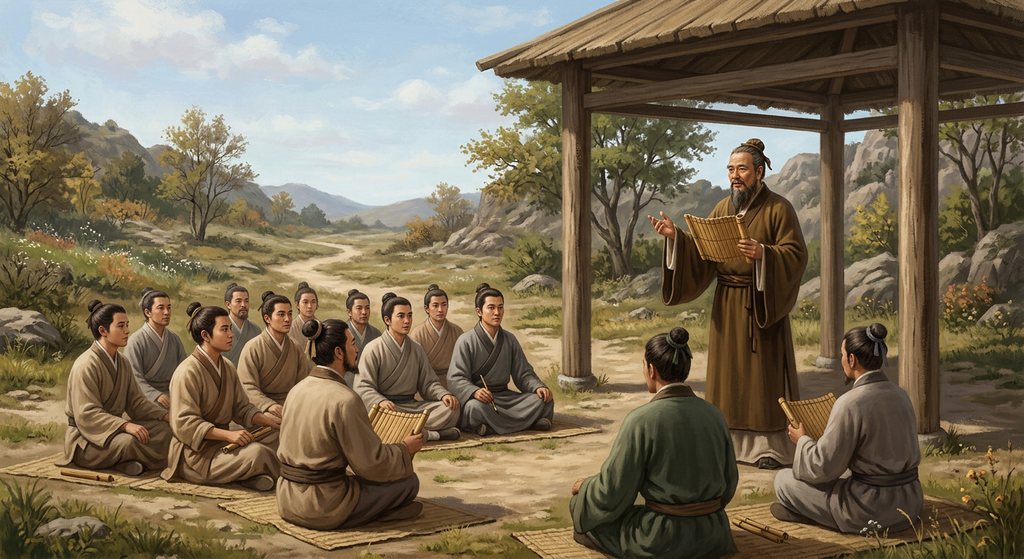
Eventually, he returned home disappointed. But his greatest success came later: he became a teacher. Not for the elite, but for everyone—even for the poor, who could only pay their tuition with a bit of food. He taught them not just to read and write, but also how to be a good person.
His Core Lessons
His core message? ‘A person is like a rough stone—polishing turns it into a gem.’ His lessons:
- Education: Lifelong learning.
- Rituals (Li): Manners create harmony.
- Humanity (Ren): ‘What you do not wish for yourself, do not do to others.’
- Family: Respect begins at home.
Confucius himself did not write any books. After his death, his students collected his teachings on bamboo slips—concise and powerful, as bamboo slips were the standard way to record texts at the time. This collection is known as the Lun Yu (The Analects).
Why Is Confucius Still Important Today?
Confucius died in 479 BCE, believing he had achieved little. But his philosophy became the foundation of Chinese culture. In countries like China, Japan, and Korea, you can still see how important education, family, and respect for elders are—thanks to this man.
Confucianism and Taoism: Contradictory or Complementary?
Taoism says: let go. Confucianism says: work hard. Contradictory?’ In the Tao, we see them as two sides of the same coin:
- Confucius = the walls and roof (rules, hard work).
- Taoism = the space inside (rest, letting go).
Without walls, there is no house. Without space, there is no life.
His Message for Today
His message is simple but powerful: The world does not improve on its own. Want a better world? Start by improving yourself, study diligently, and treat the people around you with respect.
Western Myth or Eastern Wisdom?
The famous quote "Our greatest glory is not in never falling, but in rising every time we fall" is widely attributed to Confucius. While the sentiment aligns perfectly with his philosophy of resilience, the statement likely originates from the 18th-century writer Oliver Goldsmith. He wrote this in his book The Citizen of the World as a fictional letter from a Chinese philosopher visiting London. Because the tone was so ‘Eastern’ and philosophical, the quote was mistakenly attributed to Confucius over the centuries. A beautiful example of how universal the message is!
Fun Facts About Confucius
| Point | Explanation |
|---|---|
| First Teacher | Confucius made education accessible to everyone, not just the elite. |
| 3,000 Students | He had approximately 3,000 students, 72 of whom were considered "master students." |
| Bamboo Slips | His teachings were written on bamboo slips, as this was the standard way to record texts at the time. |
Conclusion
My journey to discovering Confucius was unexpected, but his lessons are universal. Whether you’re inspired by his wisdom or simply curious, his message remains relevant. Start with yourself—and the world improves with you.
What is your experience with Confucius or Eastern philosophy? Share your thoughts in the comments!