The Hidden Transmission to Huineng
This is a beautiful Chan story about emptiness, no-self, non-attachment, and the absence of externally acquired intellect. It shows how true wisdom does not depend on words, books, or social status, but arises from direct insight and inner stillness. A story that captures the essence of Chan Buddhism and the timeless message of the Diamond Sutra.
A harsh autumn wind howled through the courtyard of the monastery in the far north, but inside the great hall, the air was heavy and still. Master Hongren, the Fifth Patriarch, sat motionless on his wooden platform. His eyes were closed, but his mind was clear and alert. He waited. Not for a calendar date, but for a shift in the universe. For the moment when the invisible thread of fate would be pulled taut.
Outside, at the gate of the monastery, stood a young man. His clothes were tattered, his feet blistered from a months-long journey on foot from the distant, impoverished south of China. His name was Huineng. He was a woodcutter, illiterate, poor, and accustomed to carrying heavy loads. But in his chest burned a fire that had been kindled on that one day in the inn, when he had heard a traveler recite the magical words of the Diamond Sutra:
"Bring the mind to life without attaching it anywhere."
Those words had awakened his soul from a millennia-long slumber. They had led him here, like a magnet attracting a particle of iron.
When Huineng entered the great hall and bowed before the Master, Hongren opened his eyes. The Master looked at the shabby figure before him. He saw the poverty, the lack of manners, the rough hands. But a Master does not look at the face; he looks at the soul. A spark of deep, age-old recognition flashed through the room. There you are, the Master thought. A conversation that had been ongoing for lifetimes was resumed in absolute silence.
But the monastery was full of highly educated monks, men of nobility and intellect who had studied the scriptures for decades. They would never accept a poor, unrefined man. The Master had to test the young man and protect him at the same time.
Hongren put on a mask of sternness. His voice echoed coldly through the hall:
"You are an illiterate barbarian from the south. How dare you come here and think you can achieve Buddha-nature?"
The young woodcutter did not hesitate for a moment. He looked the mighty Master straight in the eyes, not with arrogance, but with the pure clarity of a mountain spring.
"People come from the north or the south, Master. But Buddha-nature knows no directions. My barbarian body may differ from yours, but what separation could there possibly be between our true nature?"
A terrifying silence filled the hall. Hongren knew enough. The yuanfen was perfect. The wisdom in this young man was greater than that of all the monks in his monastery combined. But the Master kept his composure. He sniffed disdainfully, waved his hand, and said:
"Empty words. Go to the back kitchen and pound rice."
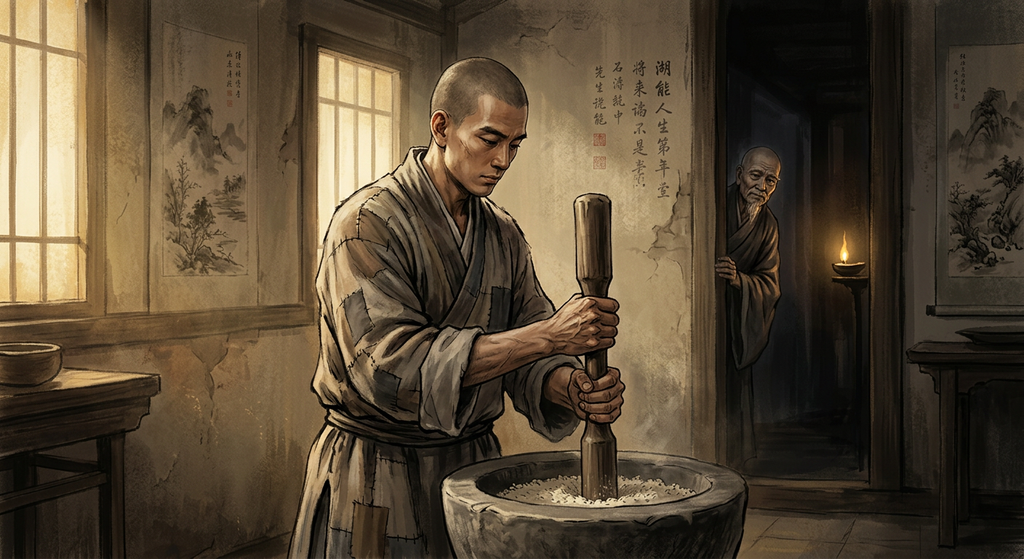
For eight months, they did not exchange a single word. Huineng worked in the dark, dusty back kitchen. He tied a heavy stone around his waist to have enough weight to move the heavy wooden rice mortar. While his body toiled, his mind was in absolute, radiant stillness. The Master would sometimes walk by, look at the toiling young man, and walk on in silence. The thread between them only grew stronger in that silence.
When winter arrived, the old Master felt his end approaching. He had to choose his successor. He asked all the monks to write a poem expressing their spiritual realization on the wall. The head monk, the most learned of them all, wrote a beautiful, intellectual poem:
The body is the Bodhi tree, The mind is like a clear mirror on a stand. Polish it constantly with care, And let no dust fall upon it.
Everyone was deeply impressed. But when Huineng heard the poem recited in the kitchen by a young novice, he smiled. He asked the novice to take a brush and write a response on the wall on his behalf, as he himself could not read a single character. Huineng dictated:
Originally, there is no Bodhi tree, Nor is there a mirror or a stand. Everything is fundamentally empty, So where could the dust possibly fall?
The next morning, the monastery buzzed with rumors. Who had written this? Master Hongren walked to the wall, read the words, and felt a shock of pure joy course through his old body. The Sixth Patriarch is in my kitchen, he realized. But he also saw the jealous glances of the other monks. To save Huineng’s life, Hongren took off his shoe, wiped the poem from the wall, and said aloud:
"This is nothing. Worthless."
That afternoon, the Master seemingly by chance walked into the back kitchen. Huineng was pounding rice, sweat on his forehead. Hongren looked at the rice and asked:
"Is the rice white yet?"
Huineng looked up and immediately understood the double meaning of the question.
"The rice has been white for a long time, Master. It is only waiting for the sieve."
The Master raised his wooden staff and struck the edge of the rice mortar three times. Then he turned around and walked away with his hands behind his back.
Huineng knew exactly what the Master meant. The three strikes represented the third hour of the night.
When the clock struck three and the entire monastery was in deep silence, Huineng slipped through the dark corridors to the Master’s room. The door was ajar. Inside, a single candle burned. Master Hongren was waiting for him with a heavy, woven robe and a tin alms bowl in his hands—the sacred relics that had been passed down from generation to generation since Bodhidharma.
No long sermons were given. No complicated rituals were needed. In the silence of that room, illuminated by the flickering candlelight, the old Master and the young woodcutter looked at each other. It was the transmission from mind to mind. Wisdom flowed from one to the other, like water poured from one bowl into another. The invisible thread had done its work; the circle was complete.
"You are now the Sixth Patriarch," Hongren whispered as he placed the robe over the young man’s shoulders. "But you must flee now. The others will seek you. Go to the south and hide until the time is ripe."
Huineng bowed deeply, took the bowl and the robe, and disappeared like a shadow into the night, into the dark mountains. He left the old Master alone in the empty room, but the spiritual flame that had brought them together would never again be extinguished.
Reflection: The Silence That Holds Everything
This story of Huineng and Hongren touches on something timeless and universal: the power of silent recognition. In a world where knowledge, status, and appearances often define worth, Chan reminds us that true wisdom is not measured in words or titles. Huineng, the illiterate woodcutter, shows that enlightenment does not depend on what you know, but on how you are.
And regarding that hidden meaning: the white rice symbolized the purity of the mind. Huineng had been engaged in spiritual cultivation for months through 'pounding the rice'. Waiting for the sieve represented the final transmission of enlightenment by the Master.
Emptiness as Foundation
Huineng’s response to Shenxiu’s poem—"Originally, there is no Bodhi tree, nor is there a mirror or a stand"—is a radical invitation to let go. Let go of images, of concepts, of the idea that something must be achieved. This is exactly what the Diamond Sutra teaches: "All that has form is empty." But emptiness here is not nothingness; it is an open space where everything can arise. Just as in Taoism, where wu (emptiness) is the source of all possibilities.
No Self, No Separation
Hongren saw Huineng’s true nature beyond his appearance. This is the core of anatta (no-self): there is no fixed, separate "I" that is superior or inferior. The division between master and student, between enlightened and unenlightened, is an illusion. This reminds me of the words from the Analects: "The wise see unity in all things." In Chan and Taoism, this unity is experiential—not something to talk about, but to live.
The Practice of the Everyday
Huineng’s eight months in the kitchen are a metaphor for the spiritual path. Enlightenment is not a future goal, but a way of being in the here and now. Whether you are pounding rice, walking, or breathing: every moment can be a moment of full presence. This is what my Master teaches me: the sacredness of the ordinary.
Silence as Language
The transmission between Hongren and Huineng happened without words. This is the power of yuanfen (spiritual connection): a deep recognition that transcends language.
A Call to Action
This story is not just a tale. It is an invitation to:
- Stop seeking—for what you seek, you already are. — want wat je zoekt, ben je al.
- Trust silence—for the answers are not in words, but in silent knowing.
- Embrace the ordinary—for enlightenment is not somewhere else, but here, now.