A new start?
You might be thinking: 'Another online page about the Tao Te Ching? There are already so many of them´. Let me get straight to the point: Yes and no!
Yes, you can read the Tao Te Ching in many places across the internet. And no, I'm not just doing that—I'm trying to add a personal touch to bring it to life, and perhaps you'll even recognize yourself in it.
Why this approach?
To turn to Confucius for a moment, he once said: ‘Learning without thought is labor lost; thought without learning is perilous.’
What I mean by this is that when you are deeply engaged with something—in my case, writing commentary alongside the existing verses of the Tao Te Ching—you learn from it yourself. In all kinds of situations, such as during conversations with others, a verse can suddenly come to mind that perfectly connects with the discussion at hand. My wife and I regularly stand in front of a classroom of children, and it is wonderful to speak about the Tao Te Ching and other wisdom from the Three Teachings in an accessible way.
A real-world example:
Recently, a conversation came up about a beautiful excursion that had been booked through an app. In the end, the experience turned out very differently from what the app had promised, leading to a costly disappointment. You might think: “Why not just refuse to pay?” But when you find yourself in a foreign country, wanting to avoid conflict—knowing that pushing back hard will almost certainly end badly—you might consciously choose to simply “let it go and pay anyway.”
Anyway, the essence of the story: suddenly, Verse 49 of the Tao Te Ching came to mind, and I said: “It is good that you stayed calm and chose acceptance.”
Why? Laozi says in Verse 49:
Those who are trustworthy, I trust. Those who are not trustworthy, I also trust. This is true trust (or: this is how trustworthiness arises).
Of course, you must always avoid projecting your own interpretations onto the original meaning of the texts. But in this case, I also look at it a bit like this: learn your lessons from what happened, and try to prevent worse in the future.
Trust is not a weakness, but a choice. By remaining open, you not only transform the people around you, but above all, you grow as a human being yourself.
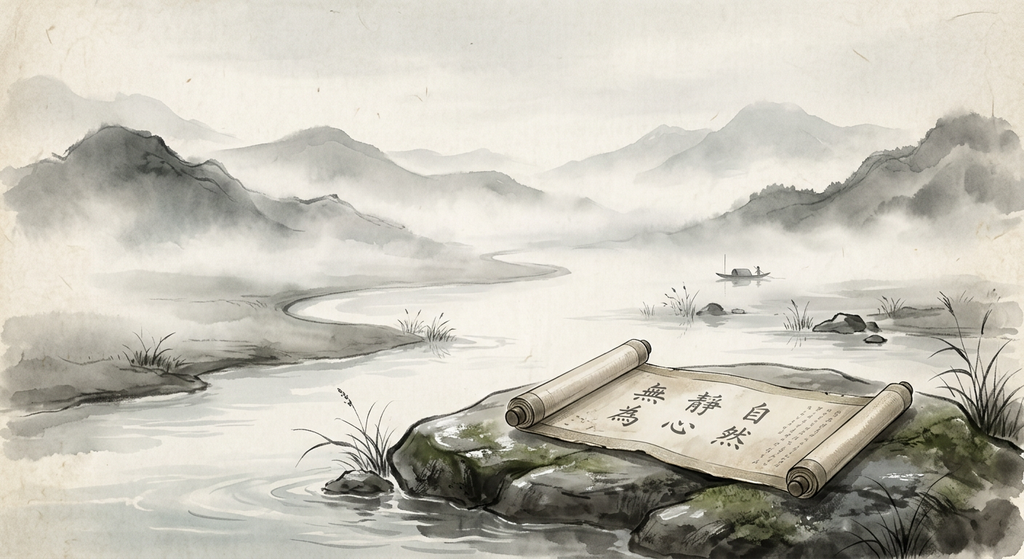
This is what Taoists call Wuwei (無為): not intervening, but allowing. It is not passivity, but a profound form of action—by not forcing, you allow the natural order to do its work.
Why read the Tao Te Ching?
Personally, I find great joy in trying to fathom the deeper layers within the texts. Ancient scriptures, translations, conversations with fellow Travelers on the Path, and, of course, regular lessons serve as my primary compass. When it comes to searching for digital sources, AI is a wonderful tool.
But even if you are just looking for simplicity and contentment, reading the Tao Te Ching is a great idea. In our consumer society, we always want more. Instead, the Tao teaches us that happiness lies in minimalism and being content with what already is. This aligns seamlessly with current trends around mindfulness and decluttering.
This approach further reminds me of the Diamond Sutra, where emptiness and form do not exclude each other, but rather complement one another. Just like in the Tao Te Ching: the nameless and the nameable are two sides of the same reality.
What can you expect here?
On these upcoming blog pages, you will find:
- The original Chinese text of each verse, including Pinyin for pronunciation.
- My own translations that stay as close to the original text as possible, yet remain easy to understand.
- Personal reflections, where possible, that connect the verses to daily life.
- Explanations that make Taoist philosophy accessible.
The Tao Te Ching is not just a book. It is a mirror that invites you to look at yourself and the world around you. Perhaps you will recognize yourself in the verses, or find comfort, inspiration, or simply a moment of peace.
Where to start?
Just choose a verse that speaks to you, or simply start with Verse 1. Let your curiosity guide you, and enjoy the journey.
I'm just getting started, so if you happen to find this page around early September 2026, please note that the blog pages are still in the making!