Tao te Ching chapter 1
Each chapter starts with the Chinese text alongside its Pinyin. Pinyin is a tool that allows us to read Chinese pronunciation using our own alphabet. That is no easy task, by the way. There are multiple tones, and if you mispronounce a word, it instantly means something completely different! That explains the diacritical marks above the letters.
| Chinese | Pinyin |
|---|---|
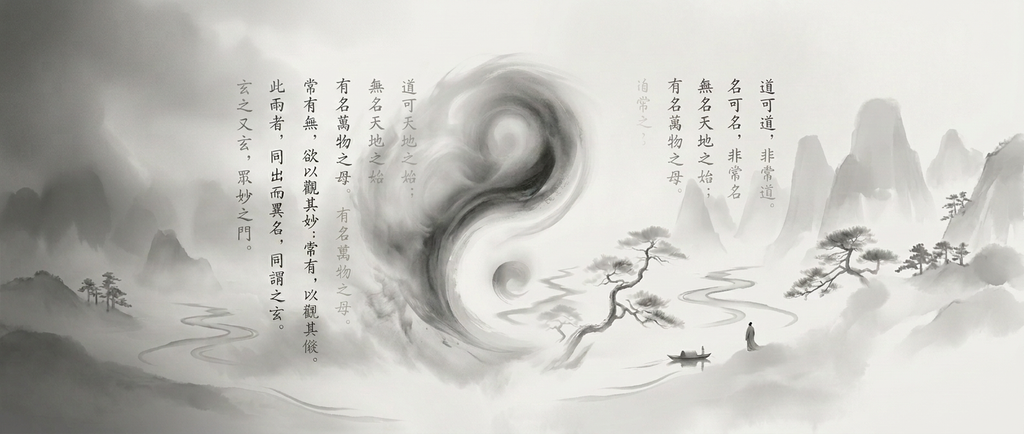
| 道可道,非常道。 | Dào kě dào, fēi cháng dào. |
| 名可名,非常名。 | Míng kě míng, fēi cháng míng. |
| 無名天地之始; | Wú míng tiān dì zhī shǐ; |
| 有名萬物之母。 | Yǒu míng wàn wù zhī mǔ. |
| 故常無欲,以觀其妙; | Gù cháng wú yù, yǐ guān qí miào; |
| 常有欲,以觀其徼。 | Cháng yǒu yù, yǐ guān qí jiào. |
| 此兩者,同出而異名, | Cǐ liǎng zhě, tóng chū ér yì míng, |
| 同謂之玄。 | Tóng wèi zhī xuán. |
| 玄之又玄,衆妙之門。 | Xuán zhī yòu xuán, zhòng miào zhī mén. |
Vertaling
| Nauwkeurig | Vlot leesbaar |
|---|---|
| De Weg die benoemd kan worden, is niet de eeuwige Weg. De naam die gegeven kan worden, is niet de eeuwige naam. | Zodra je “de Weg” kunt uitleggen, is het niet meer de echte Weg. Zodra je er een naam aan geeft, is het niet meer de oorspronkelijke Weg maar zijn het de tastbare dingen. |
| Het naamloze is de oorsprong van hemel en aarde; het benoembare is de moeder van alle dingen. | Wat nog geen naam heeft, is waar alles vandaan komt. Wat een naam heeft, is waar alles uit voortkomt. |
| Daarom: altijd zonder verlangen — en je ziet haar wonder; altijd met verlangen — en je ziet haar grens. | Wil je iets graag begrijpen, dan zie je alleen de buitenkant. Laat je verlangen los, dan zie je het wonder. |
| Deze twee ontspringen uit dezelfde bron, maar dragen verschillende namen. Beide noemen we “diepste mysterie”. Mysterie op mysterie — de poort naar alle wonderen. | Deze twee kanten komen uit dezelfde bron en zijn eigenlijk één. Zo diep dat woorden tekortschieten — en juist daar begint al het wonderlijke. |
Footnote on "all things":
In the original Chinese source text, the term used here is Wànwù (萬物), which literally translates to "the ten thousand things." In ancient China, ten thousand was used metaphorically to denote an infinite number, meaning the entirety of creation. This aligns with the famous cosmology found in Verse 42 of the Tao Te Ching: the Tao gave birth to the One, the One gave birth to the Two (Yin and Yang), the Two gave birth to the Three, and the Three gave birth to the ten thousand things (everything in existence).
Explanation:
Natural Balance and the Gateway to Wonders
This first verse of the Tao Te Ching introduces the core paradox (central contradiction) of Taoism: the Tao itself cannot be captured in words, yet it is the source of everything. Here, Laozi emphasizes two sides of the same reality:
- The nameless (無名, wu ming): The origin of heaven and earth, the emptiness from which everything arises. This is the Tao in its purest form—intangible, yet omnipresent.
- The nameable (有名, you ming): The mother of all things, the manifestation of the Tao in the world. This is the form that we can perceive.
The key lies in observation without judgment:
- Without desire (無欲, wu yu): By letting go, you can experience the wonder (妙, miao) of the Tao—the deeper reality behind the apparent contradictions.
- With desire (有欲, you yu): If you cling to desiring, you only see the boundary (徼, jiao)—the surface of things.
These two sides are not separate, but spring from the same source. Laozi calls this the “deepest mystery” (玄, xuan)—a state that goes beyond words. Ultimately, the Tao is the gateway to all wonders (衆妙之門), a reminder that everything in nature is interconnected.
Wuwei into Practice
This verse invites us to non-action (Wuwei). Instead of trying to understand or control the Tao, it is about observing and allowing. Just as you believe that everything in nature complements each other when there is no disruption, Laozi shows that opposites (such as the nameless and the nameable) complement one another in a natural balance.
Personal reflection
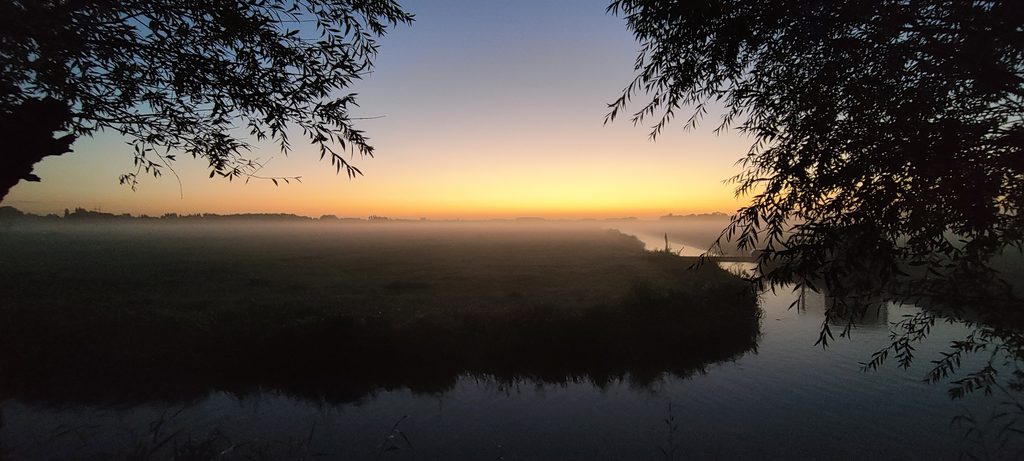
Whenever I walk or run through the polder landscapes, I am not merely observing the world—I am experiencing her. I take in the wide horizon and the whispering reeds, hear the birds chirping and the rippling water, smell the fresh earth after rain, and feel the breeze through the trees. Yet, there is something more: an invisible power supporting me. As if I belong to something much bigger.
You can't hold onto it, nor can you name it, yet you know it is there. It’s as though you briefly merge with nature. That is what the Tao feels like to me: not something to analyze, but something to experience.