Why we cherish one animal while another ends up on your plate in the evening
A quick preface. My wife and I have now been vegetarians for almost 30 years. I won't pretend I didn't eat meat myself in the past. But when you grow up as a child in a family where meat is the norm, that's simply "normal", until a change in your life pulls you out of that ignorance. I have great admiration for young children who already have this compassion from an early age, while their parents simply eat meat.
The newspaper coverage on 24 September 2026 was no small matter. A court case was needed just to be allowed to hang posters from Wakker Dier in NS train stations. Are we perhaps starting to feel uncomfortable? NS Stations preferred not to get involved in this discussion.
Anyone walking through a train station around 4 October 2026 might have seen a striking poster: a cow, a pig and a chicken on a light pink background, with the question: "Shall we try not eating 650,000 animals for one day?" It was officially Animal Day, but if Wakker Dier had its way, this time it would become "Eat No Animal Day".
Posters and data: Wakker Dier
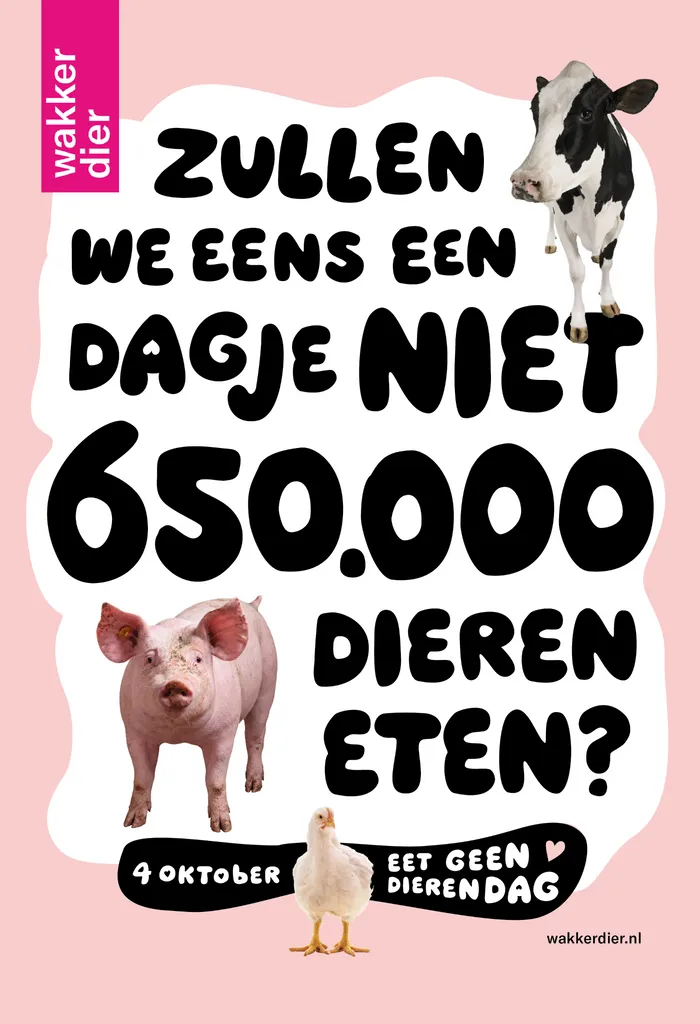
That poster was almost not allowed to hang there. NS Stations considered Wakker Dier's campaign too sensitive: too likely to spark public debate. A judge in Utrecht thought otherwise. The posters were allowed to be shown, in the week around 4 October, the Eat No Animal Day.
It's a small news item, but it raises a much older and bigger question. A question that isn't about court rulings, but about ourselves.
Two kinds of animals?
Most people who see a dog starving will intervene. A kitten in the rain is taken to the shelter. An injured bird is picked up in a towel. Compassion, real and immediate.
But at the very same moment we do this, we eat animals daily that led very different lives: pigs that are curious, eager to learn, and social, chickens with a rich social life, cows that form friendships. To be precise: some 650,000 of them, every single day — and that's in the Netherlands alone.
How can those two worlds coexist in the same head, on the same day, sometimes in the same hour?
Psychologists call this the meat paradox: we love animals and we eat them. To bear that tension, our brain splits the animal world in two. One animal becomes a "family member", the other "dinner".
In psychology, this conflict is called cognitive dissonance: the uncomfortable feeling that arises when your actions (eating meat) don't align with your deeper conviction (compassion for animals). To soothe that discomfort, we unconsciously use four powerful rationalizations. Researchers also call these the 4 N's [1]. We justify our meat consumption by believing that it is:
- Normal: Everyone around us does it; it's the social norm.
- Natural: We often justify our meat consumption by believing it is "natural", pointing to our canine teeth. Biologically speaking, humans are indeed omnivores with a multifunctional set of teeth, but our canine teeth have been reduced over the course of evolution to small teeth for grinding food, not for tearing prey apart alive. The fact that our biology enables us to digest meat doesn't mean we must do so. Precisely thanks to our flexible evolution, we can today survive perfectly and healthily on a fully plant-based diet.
- Necessary: The deeply ingrained fear that without meat we'll lack vitamins and minerals. Health authorities such as the Netherlands Nutrition Centre are clear on this: you don't need meat at all for your health. Protein, iron and B vitamins are easily obtained from legumes, nuts and whole grains. Only vitamin B12 (which is produced by bacteria) needs to be supplemented on a fully plant-based diet.
- Nice (or Necessary): We simply find it too delicious to pass up.
It's not a matter of stupidity or insensitivity; it's a psychological defence mechanism that almost everyone shares. And like most mechanisms: it only works as long as we look away.
The trick of language
One of the most curious examples lies in language itself. The living animal is called a cow, the product is called beef. The animal is a pig; in the shop it is pork, but in the pan it often simply becomes a chop. In English it's even starker: cow versus beef, pig versus pork. What we eat is no longer an animal; it has become a thing.
That's no coincidence. It's a silent creation of distance. Whoever says "cow" sees an animal with eyes. Whoever says "piece of meat" sees dinner. Language quietly does the work that our conscience would otherwise have to do.
The same applies to terms like slaughter animal, meat cattle, production animal. Even the law makes a distinction: pets are given a protective status that farm animals — legally often described as production, not as beings — enjoy far less or not at all. Yet the pig living next to your pet may be older, more curious and more social than a dog.
Oh en dan de marketing: je kent die lachende stripfiguur koeien en lachende varkentjes op de verpakking van vleeswaren, het versterkt de truc van de taal met de truc van het beeld.
Not a moral lecture
Let's be clear: this is not a plea for everyone to become vegetarian starting tomorrow. Most people who eat meat are not bad people — and that's precisely the point. They are people who would cry over an injured dog, and that same evening fry up a pork chop without thinking twice.
Incidentally, you see this mechanism very clearly in daily life. I think every vegetarian recognises it: you sit down at a dinner, say nothing about it, but the mere fact that you don't put any meat on your plate creates a palpable tension at the table. Meat eaters suddenly start apologising ("I hardly ever eat meat, you know") or become defensive. Why? Because the vegetarian at the table, entirely unintentionally, acts as a mirror. Your presence alone briefly pulls the other person out of their comfortable ignorance. The discomfort that arises is exactly the meat paradox playing out.
There is nothing wrong with compassion. On the contrary — the problem is that we carefully channel that compassion: towards the animals that happen to live within our walls, and away from the animals that happen to end up on our plates.
The mirror the poster holds up to us
The fact that a court case was needed to be allowed to show a poster with three farm animals and a simple question says it all. The Wakker Dier poster is not an attack at all! It is merely a mirror. And apparently what we see in that mirror is so confronting that NS Stations preferred to shield travellers from it.
If that discomfort is too great for the station, it shows that the meat paradox wavers the moment we are confronted with it.
The only thing that needs to happen
In the week of 24 September 2026, a simple poster with nothing but a question proved already too controversial. This raises the question of who exactly is being protected by the silence: the animals, or our own comfort?
The core is often simply daring to look without immediately judging, and being honest with yourself. If you feel discomfort at the thought of a slaughterhouse, that in itself is already an answer. Questions don't have to unleash heated debates; they may function as a small gesture of attention, like the injured bird in the towel.
This story was written from personal involvement; our whole family lives vegetarian out of compassion for animals. Choosing food that is free of suffering transcends biology and psychology, and brings inner peace. Whoever stops consuming an animal's suffering creates harmony for themselves.
Choosing plant-based (preferably unprocessed) food also reconnects you with the earth. You no longer eat from a factory system of production and consumption, but celebrate what nature gives us directly and in abundance — an awareness that brings a deep sense of gratitude to your plate.
Start with a vegetarian or meat-free day on Animal Day as a stepping stone towards structurally less meat. Because whoever dares to look into the mirror the poster holds up to us, will find the harmony that was always there.
References: