The story
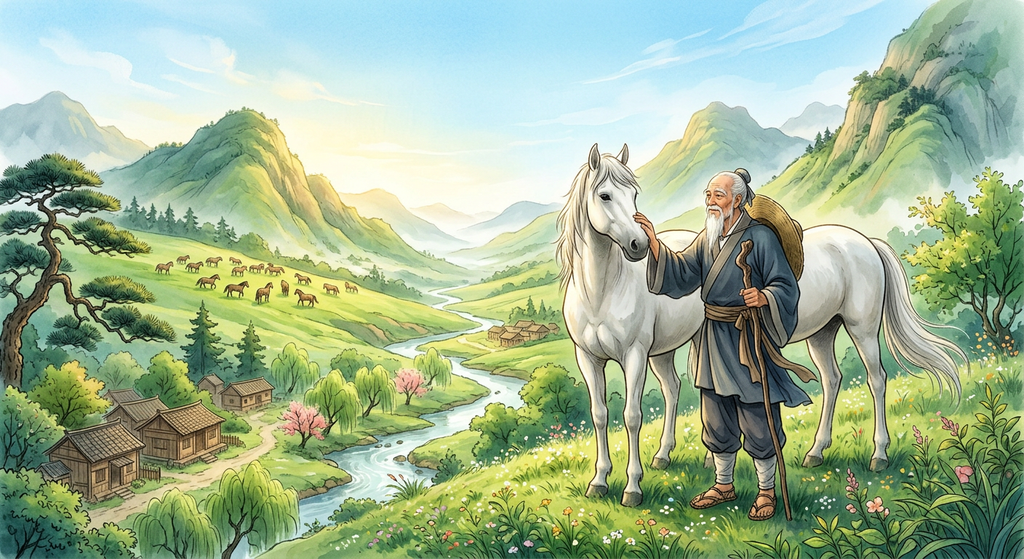
In een klein dorpje, omringd door groene heuvels, woonde een oude boer. Hij had maar één paard, maar hij hield er ontzettend veel van. Op een ochtend was de staldeur niet goed gesloten. Hierdoor kon zijn paard ontsnappen naar de wilde bergen.
The neighbors came running over. "Oh no!" they cried. "Your only horse is gone! What terrible misfortune!" The farmer looked at the open meadow, shrugged, and said calmly: "Perhaps. Perhaps not. We shall see."
A week later, something miraculous happened. The horse returned, and not alone—it had brought ten wild horses with it! The neighbors cheered. "What good luck!" they exclaimed. "From one horse to eleven! You are a rich man now!" The farmer stroked his horse and said: "Perhaps. Perhaps not. We shall see."
The next day, the farmer’s son tried to tame one of the wild horses. The horse startled, threw him off, and the son broke his leg. The neighbors shook their heads. "What a disaster!" they sighed. "Now he can’t help on the farm. What bad luck!" The farmer looked at his son, sitting painfully on the ground, and said: "Perhaps. Perhaps not. We shall see."
A few days later, the emperor’s army came to the village. War had broken out, and they were conscripting all the young, able-bodied men to fight. The neighbors wept, knowing their sons might never return. But when the soldiers reached the farmer’s house, they saw his son with his broken leg.
That evening, the neighbors gathered around the farmer. "You were right," they said to him. "We thought it was misfortune, but it turned out to be a blessing. Your son could stay safely at home!" The old farmer smiled at his son, safe at home, and said: "Perhaps. Perhaps not."
The farmers lesson: Wuwei
What was the farmer’s secret? While the neighbors swung between joy and sorrow, he remained as calm as a still lake. He did not fight life. He flowed with it, like water in a river.
The farmer taught us Wuwei (無為)—not doing nothing, but acting without resistance. It is like cycling with the wind at your back instead of against it. He did not waste energy fighting the current of life. He trusted the natural course of things.
What Is this stream (flow)?
That great, mysterious river that connects all things is called the Dao (道)—the Way. It is the invisible force that changes the seasons, makes trees grow toward the sun, and keeps the universe in balance. Nature follows the Dao perfectly, without effort.
The caring source behind the stream (flow)
In chapter 1 of the Tao Te Ching, this cosmic flow is described as the Mother of the ten thousand things, the loving origin of all. The Tao does not force nor rule with a heavy hand, but allows life to arise and grow organically, just as a mother cares for her children.
When the farmer moves with the Dao and practices Wuwei, he rests in the deep trust that he is carried by this natural, nurturing stream. He does not fight the current but lets himself be guided by the wisdom of nature itself.
A question to carry with You
This story invites for reflection: How often do we fight the current? How often do we call something "bad luck" or "good luck", when we don’t yet know how it will end?
The farmer teaches us that trusting the Dao, trusting the natural flow of life, brings peace. Maybe it’s as simple as this: move with the stream (flow) rather than against it.
What do you learn from this story?
Leave a Reply