The mind as a prison: Freedom through letting go
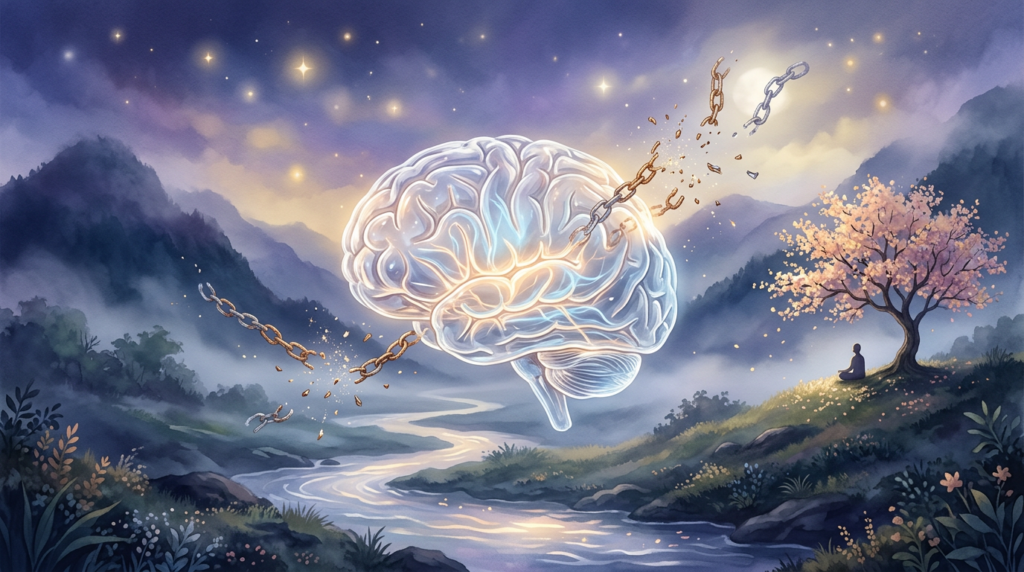
Our minds may well be the greatest prison we will ever know. Not because they physically confine us, but because they trap us in our own thoughts, beliefs, and fixations.
As a wise person once said: "It is perfectly possible for a man to be out of prison, and yet not free—to be under no physical constraint and yet to be a psychological captive." We move through the world, free in our actions, yet our minds can keep us captive in an endless loop of repeating patterns, fears, and attachments.
In Taoism and Buddhism, it is emphasized that true freedom comes through letting go. The Diamond Sutra teaches us that even the most sacred concepts, such as "Buddha" or "enlightenment," must be released to attain true wisdom. But how do we apply this in daily life? How do we recognize the walls we have built ourselves, and how can we tear them down?
The mind: Teacher and prison
The mind can be both our greatest teacher and our greatest obstacle. It forces us to observe ourselves, to recognize patterns in our thoughts, and to gain deeper insight into who we are. Yet, at the same time, it can trap us in a web of fixations. "The brain can be both your greatest teacher and your greatest obstacle."
Imagine standing in a room full of mirrors. Wherever you look, you see yourself. You can study every angle of yourself, but none of those mirrors will show you a way out. Doesn’t that feel like being stuck in our own thoughts? We analyze, reflect, and try to understand, yet we often remain trapped in the same patterns.
Fixations: The Invisible chains
Fixations are the invisible chains that keep us captive. They can be rigid beliefs, such as "I must be perfect—just look at social media, where everyone seems perfect" or "The world must be fair," or emotional attachments to people, memories, or material possessions. All these fixations limit us and keep us trapped in a cycle of emotional tension, jealousy, dissatisfaction, and so on.
In Buddhism, this is called the "Wheel of Life"—an endless cycle of desire, attachment, and suffering. In Taoism, the concept of wuwei (無為), or effortless action, is seen as the key to freedom. But how do we recognize these fixations in our own lives?
Letting go as the path to freedom
Letting go is not a one-time act but a continuous process. It begins with awareness: recognizing the thoughts and beliefs that hold you captive. Ask yourself: "Is this a fact, or an interpretation? What is actually happening now: am I a participant or an observer?" and "What would happen if I let this thought go?"
Often, one negative thought leads to more negative thoughts.
You might think: "Easy for you to say—you don’t know my problems." And that’s true, of course. But if you keep getting stuck in the same thoughts that create a spiral of negativity, does it really help to keep dwelling on them? Often, you suffer, but so do the people around you who start to worry.
Possible steps to release fixations
- Awareness: Take the time to observe your thoughts. Write them down if it helps. What are the recurring themes?
- Meditation: Spend a few minutes each day sitting quietly, letting your thoughts drift by like clouds in the sky. You don’t need to hold onto them.
- Wuwei (無為): Act without forcing. Let things unfold as they will, without clinging to them.
- Nature as a Mirror: Go for a walk, run, bike ride, or simply sit in nature and observe how everything is—without attaching to anything. This is hán dé (含德), the virtue of understanding the Tao (the ineffable, the unnameable—but more on that later).
Persoonlijke reflectie
I find my greatest freedom in nature: walking for hours in a forest or through the Broekpolder, far from the noise and distractions of the city. Walking isn’t just good for the body—it clears the mind, too. Wonderful, isn’t it?
By immersing myself in the Three Teachings and the Diamond Sutra, I’ve come to see the beauty in nature and all the small things around us—things we often overlook in the rush of daily life.
A new start?
Het brein hoeft geen gevangenis te zijn. Door bewust te worden van onze fixaties en ze stap voor stap los te laten, kunnen we de muren afbreken die we zelf hebben gebouwd. Ware vrijheid ligt niet in het ontvluchten van onze gedachten, maar in het leren leven met ze, zonder ons eraan vast te klampen. Het hoeft en gaat niet in één dag. Confucius zei ooit ¨Het doet er niet toe hoe langzaam je gaat, zolang je maar niet stopt.¨
Question for the reader
How could you let go of your own fixations, even if just for a moment? Share your experiences in the comments.
Leave a Reply