
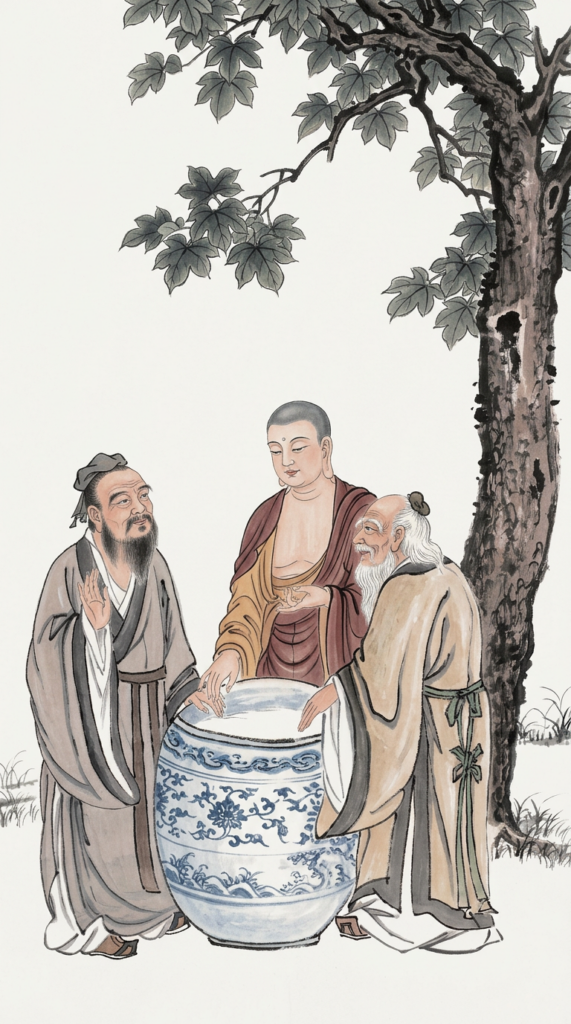
Do you know the story of the Vinegar Tasters? This tale beautifully illustrates how one can experience the world. In the image, there is a large vat of vinegar and the three great Sages of China: Confucius, Buddha, and Laozi.The vinegar in the vat is a metaphor for life itself. The way each of them reacts to the taste—sour, bitter, or sweet—reflects the core of their life philosophy.
The Story
On a sunny day in a small village in ancient China, three wise men stood by a large vat of vinegar. Each dipped a finger into the vat and tasted it.
But what happened? They all responded differently!
Dit is het verhaal van Confucius, Laozi and Buddha, and what we can learn from them.
The Vinegar Pot
In the heart of the village stood a large vat of vinegar. Vinegar is sour, and not everyone likes it. But on this day, three great teachers decided to taste it.
They wanted to know: What does life actually taste like?
Confucius: The Teacher of Order
Confucius dipped his finger into the pot and tasted. He pulled a sour face.
“This is not good!”, he thought. “Het leven zou zoeter moeten zijn.
We moeten harder werken om de wereld beter te maken.”
Voor Confucius was het leven als een les die we moeten leren.
Hij gelooft in respect, good behavior, and following rules to create harmony.
Lao Tzu: The Sage of Nature
Laozi dipped his finger into the pot and tasted. He smiled.
“Life is as it is”, he thought. “Soms is het zuur, soms zoet.
Maar als we meegaan met de stroom, zoals een rivier, dan is alles in balans.”
Voor Lao Zi is het leven als een boom die groeit zonder haast.
Hij leert ons om let go and trust the natural way.
Buddha: The Enlightened One
Buddha dipped his finger into the pot and tasted. Although the taste of the vinegar was bitter — a symbol of the suffering inherent to earthly life — he did not judge.
He remained completely calm and serene.
“The vinegar is just vinegar”, he thought. “Suffering only arises when we fight against how things are, or when we desire for the bitter to become sweet.”
For Buddha, life is a succession of experiences that we without judgment must observe to find inner peace.
What can we learn from it?
| Wise | Response | Reading for Us |
|---|---|---|
| Confucius | Sour face | Be responsible. Work hard to make the world a better place. |
| Laozi | Smile | Accept life as it is. Trust the natural balance. |
| Buddha | Calm and neutral | Let go of what you cannot change. Find peace in the moment. |
A Reflection
When you look at these three sages, you see that none of them are “wrong.” Confucius reminds us that we must actively contribute to a better world, Lao Zi teaches us to let go and trust the natural course of things, and Buddha shows us how to find freedom through non-judgment. Perhaps the greatest wisdom is to carry all three lessons in your heart: do what you can, let go of what you cannot change, and remain calm amidst it all. That is how I see it myself as well.
Leave a Reply