
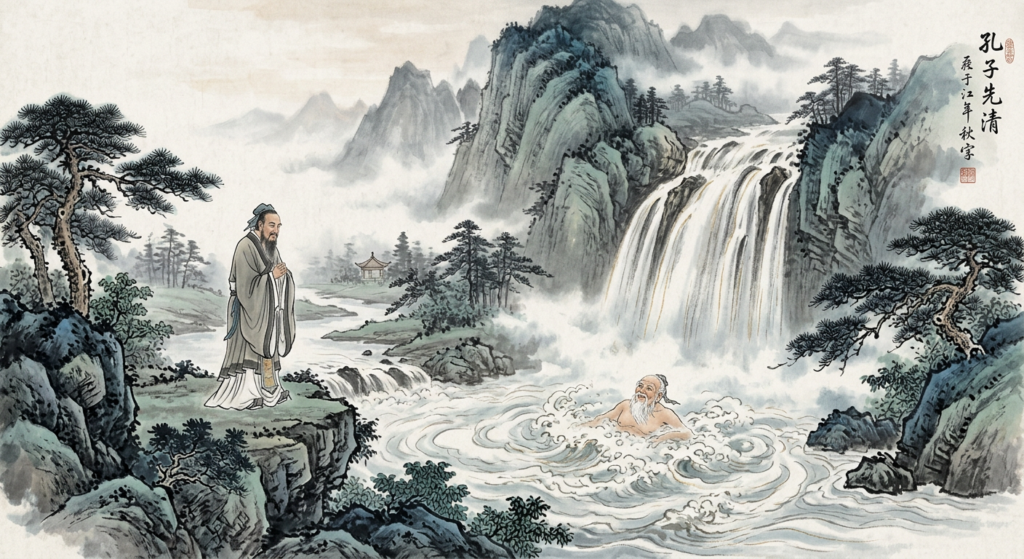
This is the story of Confucius and the swimmer at the Lüliang Waterfall..
Several waterfalls can be found throughout the Lüliang Mountains. A famous waterfall sharing this name (呂梁瀑布) plays a major role in classical Taoist stories, such as the Zhuangzi. Although historians suspect that the specific waterfall from the parable was actually located in a different region at the time, its symbolism is strongly associated with the rugged mountain landscape of Lüliang today. In the story, a swimmer survives the roaring torrent by completely adapting to the water. In doing so, the waterfall symbolizes the natural strength, flexibility, and harmony (wu wei) that are central to Taoism.
It is a story that makes you reflect on how we approach life. In this story, we see how natural harmony and spontaneity are the key to true wisdom.
Just like The Vinegar Tasters, this story explores three ways of looking at the world, but with a different perspective: the power of letting go and going with the flow.
The Story
One day, Confucius visited the Lüliang Waterfall, where the water cascaded down with tremendous force. The flow was so wild that even large water creatures could not swim in it. Suddenly, Confucius saw a man calmly moving in the water, as if he were taking a leisurely stroll. He thought the man was in distress and sent his disciples to rescue him.
But when the man emerged, he was singing and walking along the shore, as if nothing had happened. Confucius, amazed, asked: "How can you remain so calm while swimming in such turbulent waters? Do you have a special method?" The man replied: "I follow no method. I began with my nature, grew with my character, and completed with my destiny. I go with the flow, just like the water itself."
The Lüliang waterfall
In ancient China, the Lüliang Waterfall was known for its unstoppable power. The water plunged thirty ren (about 200 meters) down and carried foam forty li (over 20 kilometers) away. For most people, it was impossible to swim there. But for the swimmer, it was as natural as walking on the ground.
Confucius: The Seeker of Method
Confucius looked at the swimmer and saw danger. To him, life was something that had to be understood and mastered through knowledge, rules, and effort. "How can someone simply swim in that water?", he thought. "There must be a reason, a lesson we can learn."
For Confucius, life was like a book to be studied. He believed in responsibility, learning, and improving the world through action.
The Swimmer: The Master of the Flow
The swimmer smiled and said: "I do nothing special. I simply am. I was born on the hills and feel at home on the hills. I grew up in the water and feel at home in the water. I don’t know why I can do this—it just happens."
For the swimmer, life was like a river: you don’t need to fight the current; you only need to go with it. He teaches us to trust our natural selves and follow the way of the water.
The Lesson of Laozi (Implicitly Present)
Although Laozi does not appear in this story, you can feel his wisdom in the swimmer’s words. For Laozi, life is like water: soft yet unstoppable. It follows its own path without resistance. The swimmer lives this philosophy—he does not do, he simply is.
What can we learn from it?
De Zwemmer en de Weg van het Water
| Persoon | Response | Reading for Us |
|---|---|---|
| Confucius | Seeks a method | Learn and work hard, but be aware of the limits of knowledge. limieten van kennis. |
| The Swimmer | Goes with the flow | Trust your natural self and let go of what you cannot control. |
| Laozi | Water as a metaphor | Be like water: flexible, adaptable, and in harmony with the Dao. |
A Reflection
When looking at Confucius and the swimmer, you see two opposing yet complementary approaches. Confucius teaches us that knowledge and effort are important, but the swimmer shows that natural harmony is just as valuable. Perhaps the greatest wisdom is to embrace both lessons: learn and do what you can, but let go of what is beyond your control.
Just like The Vinegar Tasters, it’s about carrying different perspectives in your heart. Sometimes life is sour, sometimes sweet, and sometimes you just have to go with the flow.
I think the complementarity between the Teachings is fantastic!
Leave a Reply