
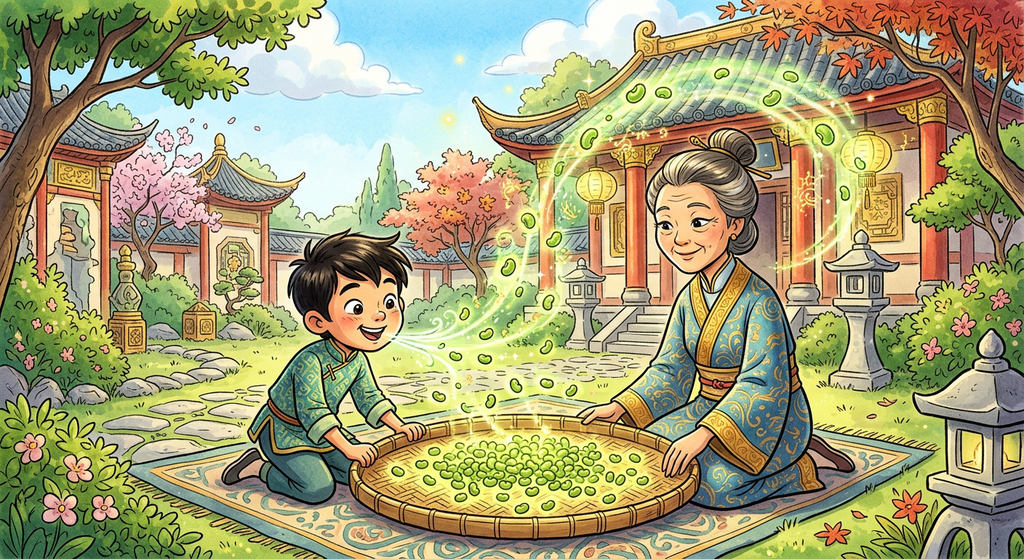
The magical story of the green beans
In a faraway land, in a beautiful temple, there lived a wise and kind teacher. One sunny day, someone brought a bag of green beans to the temple.
These beans had just been harvested and needed to dry in the sun.
The teacher placed the beans in a large basket and set them in the garden. Suddenly, she saw a boy whom everyone called Little Silver. He gently blew on the beans, causing them to fly in all directions! Kleine Zilver werd genoemd. Hij blies voorzichtig over de bonen, waarna ze alle kanten op vlogen!
Little Silver, why are you blowing on those beans?" the teacher asked. "They will fall on the ground and get dirty!
The boy looked up and smiled. "I’m not Little Silver," he said. "I am now a living Buddha!"
The always calm teacher was startled. She saw that the boy looked different from usual. She knelt down and bowed deeply. "Venerable Buddha," she asked, "why are you blowing on these beans?"
The Buddha, speaking through the boy, said: "I am blowing magical power into these beans. Now they are magic beans! Whoever eats one will get better, no matter what illness they have."
The teacher was moved. She thanked the Buddha, and from that day on, the green beans were magical. Whenever someone was sick, the teacher would give them a magic bean, and the person would recover.
In the temple, there was also Grandma Wuwei, a kind old lady who came every day to clean and sweep. She had been doing this for many years, day in and day out. But one day, Grandma Wuwei did not show up.
The teacher sent someone to check on her. It turned out that Grandma Wuwei was sick. She had heard that the green beans were magical and had secretly eaten two beans, hoping she would get better. But instead, she got severe stomach pain and could not stand up.
The teacher immediately understood what had happened. "Grandma Wuwei was not honest," she thought. "If she was sick, she could have just told me. Then I would have given her beans. Now she is being punished because she secretly took them."
The teacher had Grandma Wuwei brought to the temple. She lit 108 large incense sticks and prayed for her. Grandma Wuwei bowed deeply and said she was very sorry.
After these sincere prayers, she felt better again.
The lesson of the story
If you need something, always ask for it in an honest way. Taking things secretly will eventually lead to problems. Always be honest and respectful!
Why 108 Incense Sticks?
In Buddhism, the number 108 is associated with the 108 worldly desires or illusions (Sanskrit: kleshas), which can distract a person from achieving enlightenment. These desires are categorized in a structured way:
- 6 Senses: Buddhism recognizes 6 senses (unlike the typical 5 in Western thought). In addition to sight, hearing, smell, taste, and touch, there is also thought as a sense. This includes all mental impressions and ideas we form.
- 3 Time Periods: Desires can manifest in the past, present, or future. This emphasizes that desires are not only present in the current moment but also arise from memories or expectations.
- 3 Feelings: Every experience or desire can lead to pleasure, pain, or neutrality. These three feelings describe how we react to what we perceive.
- 2 Reactions: For each feeling, we can be attracted or repelled. For example: if we experience something pleasant, we want to hold onto it (attraction), and if we experience pain, we want to avoid it (repulsion).
6 senses × 3 time periods × 3 feelings × 2 reactions = 108
By lighting 108 incense sticks, one symbolizes the release of all these desires and illusions, leading to purification and spiritual growth.
- Mala (Prayer Beads): A mala often has 108 beads, which are used to recite mantras. Each bead represents a step in the spiritual journey.
2. Taoist Meaning
- 108 Virtues: Virtues one must cultivate to live in harmony with the Tao.
- 108 Inner Demons: Demons that must be overcome to achieve true wisdom.
- 108 Movements: In traditional Taoist meditations or martial arts (such as Tai Chi).
3. Mathematical and Astronomical Symbolism
- Vedic Mathematics: 12 (months) × 9 (planets) = 108.
- Cosmic Harmony: The diameter of the sun is approximately 108 times that of the Earth, and the distance between the Earth and the sun is approximately 108 times the diameter of the sun.
4. Practical Application in Rituals
- Purification: Driving away negative energy.
- Gratitude: For the Buddha, the teacher, or the universe.
- Gratitude: For the Buddha, the teacher, or the universe.
Leave a Reply