Virtues and merits: the difference
Some time ago, I took an English class about virtues and merits. I understood the words, but the difference between the two remained a mystery. Until I came across the metaphor of the raft—and suddenly, it clicked. But as always in spiritual traditions: behind every solution lies a new layer of depth. What if I told you that even the raft is ultimately an illusory tool?
In a nutshell, here’s how it works:
Virtues are like the compass in your heart: compassion, patience, wisdom. They are the qualities that help you let go of selfishness and negative emotions.
Merits are the steps you take when you follow that compass: helping a stranger, donating to a good cause, cultivating inner peace. Virtues are what you carry; merits are what you do.
The raft: a journey toward enlightenment
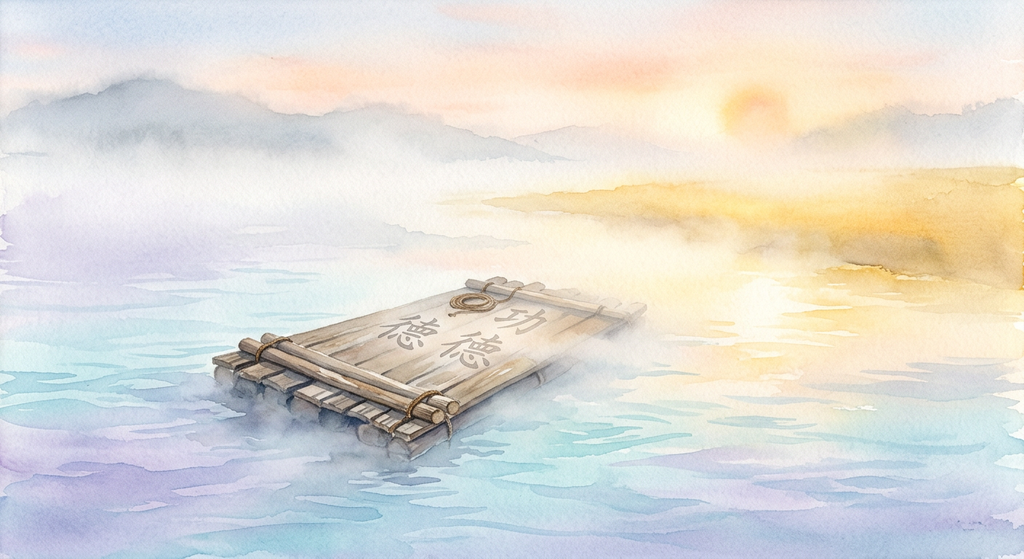
But how do these two—virtues and merits—fit together? This is where the metaphor of the raft comes in.
Imagine you’re standing on one side of a wild river—let’s call it the dangerous side—and you want to reach the other side, where it’s safe. In Buddhism, the dangerous shore represents our chaotic, superficial lives. The other side isn’t a physical place but a state of being: a purity of mind in which you are completely free from ego, status, possessions, and jealousy.
To make that crossing, you start building. With your virtues—your active commitment to compassion, patience, and wisdom—you gather the materials to build a sturdy raft. The stability of your raft comes from your merits. Without merits, your raft would capsize in the turbulent currents of daily life. Merits are the invisible force that keeps your raft afloat, the spiritual fuel that carries you safely to the other side.
The paradox: why you must let go of the raft
And here’s the big turning point. No matter how sturdy your raft is, no matter how safely it carries you to the other side—it remains a raft.
And rafts are not meant to be carried along.
The Diamond Sutra stirs the pot by saying that everything is essentially 'empty.' Your virtues, your merits, even the raft. They are means, not ends.
Imagine this: you’re standing on the other side, safe and free. What do you do with the raft? You could take it with you, but then it becomes a heavy burden on your back. You could be proud of it, but then it becomes a subtle, new form of spiritual ego and attachment.
So use the raft, but don’t carry it with you. If you keep repeating on the other side how virtuous you are or how many merits you’ve accumulated, you’re still dragging that raft along in your mind. And that’s exactly what the Diamond Sutra warns against: even the pursuit of goodness can become a pitfall if you cling to the concept itself.
Acting without attachment
The deeper lesson of the Diamond Sutra is that true purity only arises when you can even let go of the urge to 'be good' or 'earn spiritual points.' You simply are free, without needing to hold onto the raft.
So the next time you perform a good deed or cultivate a virtue, ask yourself: am I building this raft to reach the other side, or have I secretly fallen in love with the raft itself?
Leave a Reply