Some time ago, I took an English class about virtues and merits. I understood the words, but the difference between the two remained a mystery. Until I came across the metaphor of the raft—and suddenly, it clicked. But as always in spiritual traditions: behind every solution lies a new layer of depth. What if I told you that even the raft is ultimately an illusory tool?
In a nutshell, here’s how it works:
Virtues are like the compass in your heart: compassion, patience, wisdom. They are the qualities that help you let go of selfishness and negative emotions.
Merits are the steps you take when you follow that compass: helping a stranger, donating to a good cause, cultivating inner peace. Virtues are what you carry; merits are what you do.
The raft: a journey toward enlightenment
But how do these two—virtues and merits—fit together? This is where the metaphor of the raft comes in.
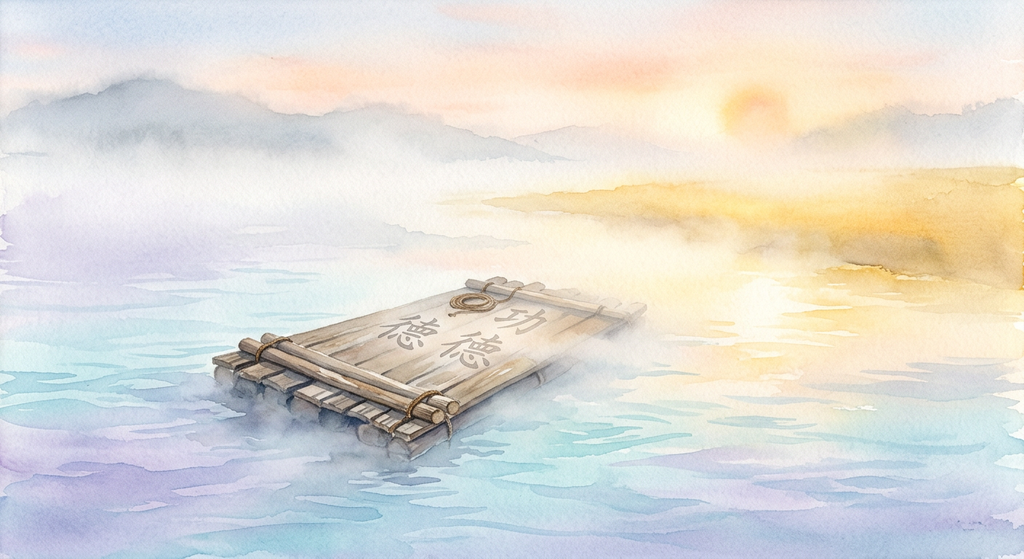
Imagine you’re standing on one side of a wild river—let’s call it the dangerous side—and you want to reach the other side, where it’s safe. In Buddhism, the dangerous shore represents our chaotic, superficial lives. The other side isn’t a physical place but a state of being: a purity of mind in which you are completely free from ego, status, possessions, and jealousy.
To make that crossing, you start building. With your virtues—your active commitment to compassion, patience, and wisdom—you gather the materials to build a sturdy raft. The stability of your raft comes from your merits. Without merits, your raft would capsize in the turbulent currents of daily life. Merits are the invisible force that keeps your raft afloat, the spiritual fuel that carries you safely to the other side.
The paradox: why you must let go of the raft
And here’s the big turning point. No matter how sturdy your raft is, no matter how safely it carries you to the other side—it remains a raft.
And rafts are not meant to be carried along.
The Diamond Sutra stirs the pot by saying that everything is essentially 'empty.' Your virtues, your merits, even the raft. They are means, not ends.
Imagine this: you’re standing on the other side, safe and free. What do you do with the raft? You could take it with you, but then it becomes a heavy burden on your back. You could be proud of it, but then it becomes a subtle, new form of spiritual ego and attachment.
So use the raft, but don’t carry it with you. If you keep repeating on the other side how virtuous you are or how many merits you’ve accumulated, you’re still dragging that raft along in your mind. And that’s exactly what the Diamond Sutra warns against: even the pursuit of goodness can become a pitfall if you cling to the concept itself.
Acting without attachment
The deeper lesson of the Diamond Sutra is that true purity only arises when you can even let go of the urge to 'be good' or 'earn spiritual points.' You simply are free, without needing to hold onto the raft.
So the next time you perform a good deed or cultivate a virtue, ask yourself: am I building this raft to reach the other side, or have I secretly fallen in love with the raft itself?
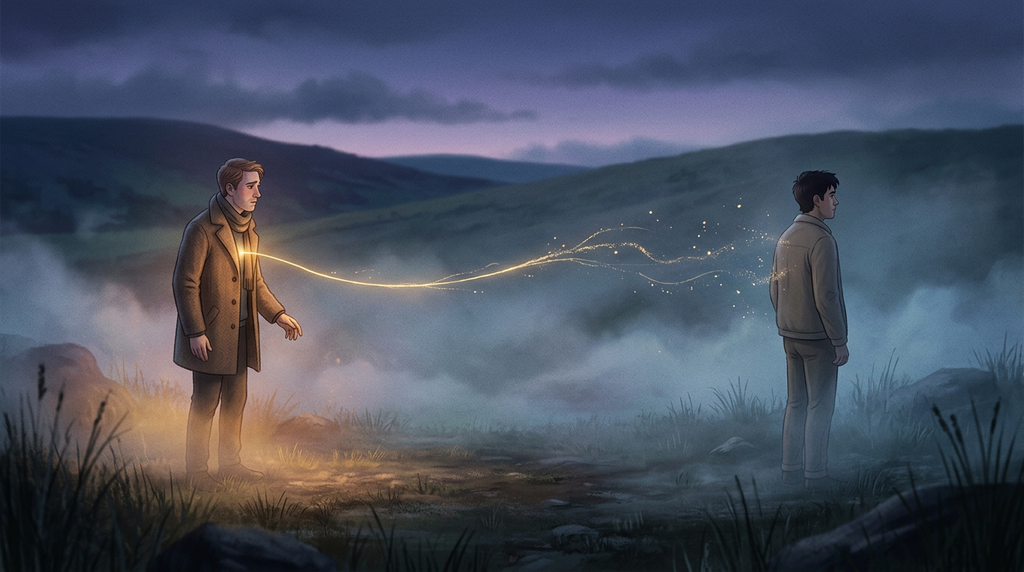
Affinity strikes like a flash of light, suddenly it is here;
Walking together on the Path; a subconscious recognition;
Whether there is a reason, it matters not;
It is beautiful and precious, not to be possessed but to be cherished;
Grateful for the moment;
Together on the Path, together growing.
A flash is brief and fades away, yet the essential recognition remains;
Until the Path brings you back together once again.
This is a beautiful Chan story about emptiness, no-self, non-attachment, and the absence of externally acquired intellect. It shows how true wisdom does not depend on words, books, or social status, but arises from direct insight and inner stillness. A story that captures the essence of Chan Buddhism and the timeless message of the Diamond Sutra.
A harsh autumn wind howled through the courtyard of the monastery in the far north, but inside the great hall, the air was heavy and still. Master Hongren, the Fifth Patriarch, sat motionless on his wooden platform. His eyes were closed, but his mind was clear and alert. He waited. Not for a calendar date, but for a shift in the universe. For the moment when the invisible thread of fate would be pulled taut.
Outside, at the gate of the monastery, stood a young man. His clothes were tattered, his feet blistered from a months-long journey on foot from the distant, impoverished south of China. His name was Huineng. He was a woodcutter, illiterate, poor, and accustomed to carrying heavy loads. But in his chest burned a fire that had been kindled on that one day in the inn, when he had heard a traveler recite the magical words of the Diamond Sutra:
"Bring the mind to life without attaching it anywhere."
Those words had awakened his soul from a millennia-long slumber. They had led him here, like a magnet attracting a particle of iron.
When Huineng entered the great hall and bowed before the Master, Hongren opened his eyes. The Master looked at the shabby figure before him. He saw the poverty, the lack of manners, the rough hands. But a Master does not look at the face; he looks at the soul. A spark of deep, age-old recognition flashed through the room. There you are, the Master thought. A conversation that had been ongoing for lifetimes was resumed in absolute silence.
But the monastery was full of highly educated monks, men of nobility and intellect who had studied the scriptures for decades. They would never accept a poor, unrefined man. The Master had to test the young man and protect him at the same time.
Hongren put on a mask of sternness. His voice echoed coldly through the hall:
"You are an illiterate barbarian from the south. How dare you come here and think you can achieve Buddha-nature?"
The young woodcutter did not hesitate for a moment. He looked the mighty Master straight in the eyes, not with arrogance, but with the pure clarity of a mountain spring.
"People come from the north or the south, Master. But Buddha-nature knows no directions. My barbarian body may differ from yours, but what separation could there possibly be between our true nature?"
A terrifying silence filled the hall. Hongren knew enough. The yuanfen was perfect. The wisdom in this young man was greater than that of all the monks in his monastery combined. But the Master kept his composure. He sniffed disdainfully, waved his hand, and said:
"Empty words. Go to the back kitchen and pound rice."
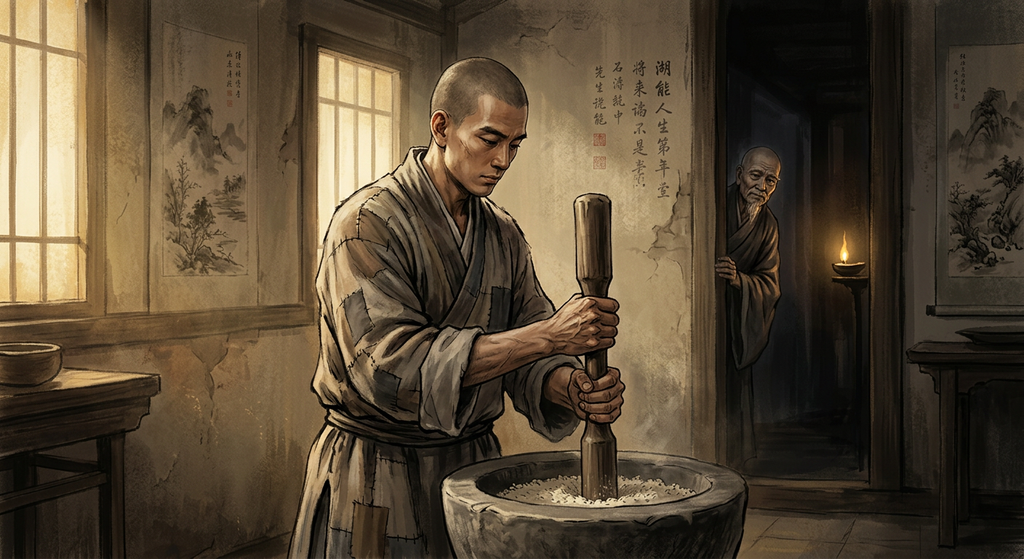
For eight months, they did not exchange a single word. Huineng worked in the dark, dusty back kitchen. He tied a heavy stone around his waist to have enough weight to move the heavy wooden rice mortar. While his body toiled, his mind was in absolute, radiant stillness. The Master would sometimes walk by, look at the toiling young man, and walk on in silence. The thread between them only grew stronger in that silence.
When winter arrived, the old Master felt his end approaching. He had to choose his successor. He asked all the monks to write a poem expressing their spiritual realization on the wall. The head monk, the most learned of them all, wrote a beautiful, intellectual poem:
The body is the Bodhi tree,
The mind is like a clear mirror on a stand.
Polish it constantly with care,
And let no dust fall upon it.
Everyone was deeply impressed. But when Huineng heard the poem recited in the kitchen by a young novice, he smiled. He asked the novice to take a brush and write a response on the wall on his behalf, as he himself could not read a single character. Huineng dictated:
Originally, there is no Bodhi tree,
Nor is there a mirror or a stand.
Everything is fundamentally empty,
So where could the dust possibly fall?
The next morning, the monastery buzzed with rumors. Who had written this? Master Hongren walked to the wall, read the words, and felt a shock of pure joy course through his old body. The Sixth Patriarch is in my kitchen, he realized. But he also saw the jealous glances of the other monks. To save Huineng’s life, Hongren took off his shoe, wiped the poem from the wall, and said aloud:
"This is nothing. Worthless."
That afternoon, the Master seemingly by chance walked into the back kitchen. Huineng was pounding rice, sweat on his forehead. Hongren looked at the rice and asked:
"Is the rice white yet?"
Huineng looked up and immediately understood the double meaning of the question.
"The rice has been white for a long time, Master. It is only waiting for the sieve."
The Master raised his wooden staff and struck the edge of the rice mortar three times. Then he turned around and walked away with his hands behind his back.
Huineng knew exactly what the Master meant. The three strikes represented the third hour of the night.
When the clock struck three and the entire monastery was in deep silence, Huineng slipped through the dark corridors to the Master’s room. The door was ajar. Inside, a single candle burned. Master Hongren was waiting for him with a heavy, woven robe and a tin alms bowl in his hands—the sacred relics that had been passed down from generation to generation since Bodhidharma.
No long sermons were given. No complicated rituals were needed. In the silence of that room, illuminated by the flickering candlelight, the old Master and the young woodcutter looked at each other. It was the transmission from mind to mind. Wisdom flowed from one to the other, like water poured from one bowl into another. The invisible thread had done its work; the circle was complete.
"You are now the Sixth Patriarch," Hongren whispered as he placed the robe over the young man’s shoulders. "But you must flee now. The others will seek you. Go to the south and hide until the time is ripe."
Huineng bowed deeply, took the bowl and the robe, and disappeared like a shadow into the night, into the dark mountains. He left the old Master alone in the empty room, but the spiritual flame that had brought them together would never again be extinguished.
Reflection: The Silence That Holds Everything
This story of Huineng and Hongren touches on something timeless and universal: the power of silent recognition. In a world where knowledge, status, and appearances often define worth, Chan reminds us that true wisdom is not measured in words or titles. Huineng, the illiterate woodcutter, shows that enlightenment does not depend on what you know, but on how you are.
And regarding that hidden meaning: the white rice symbolized the purity of the mind. Huineng had been engaged in spiritual cultivation for months through 'pounding the rice'. Waiting for the sieve represented the final transmission of enlightenment by the Master.
Emptiness as Foundation
Huineng’s response to Shenxiu’s poem—"Originally, there is no Bodhi tree, nor is there a mirror or a stand"—is a radical invitation to let go. Let go of images, of concepts, of the idea that something must be achieved. This is exactly what the Diamond Sutra teaches: "All that has form is empty." But emptiness here is not nothingness; it is an open space where everything can arise. Just as in Taoism, where wu (emptiness) is the source of all possibilities.
No Self, No Separation
Hongren saw Huineng’s true nature beyond his appearance. This is the core of anatta (no-self): there is no fixed, separate "I" that is superior or inferior. The division between master and student, between enlightened and unenlightened, is an illusion. This reminds me of the words from the Analects: "The wise see unity in all things." In Chan and Taoism, this unity is experiential—not something to talk about, but to live.
The Practice of the Everyday
Huineng’s eight months in the kitchen are a metaphor for the spiritual path. Enlightenment is not a future goal, but a way of being in the here and now. Whether you are pounding rice, walking, or breathing: every moment can be a moment of full presence. This is what my Master teaches me: the sacredness of the ordinary.
Silence as Language
The transmission between Hongren and Huineng happened without words. This is the power of yuanfen (spiritual connection): a deep recognition that transcends language.
A Call to Action
This story is not just a tale. It is an invitation to:
Stop seeking—for what you seek, you already are. — want wat je zoekt, ben je al.
Trust silence—for the answers are not in words, but in silent knowing.
Embrace the ordinary—for enlightenment is not somewhere else, but here, now.
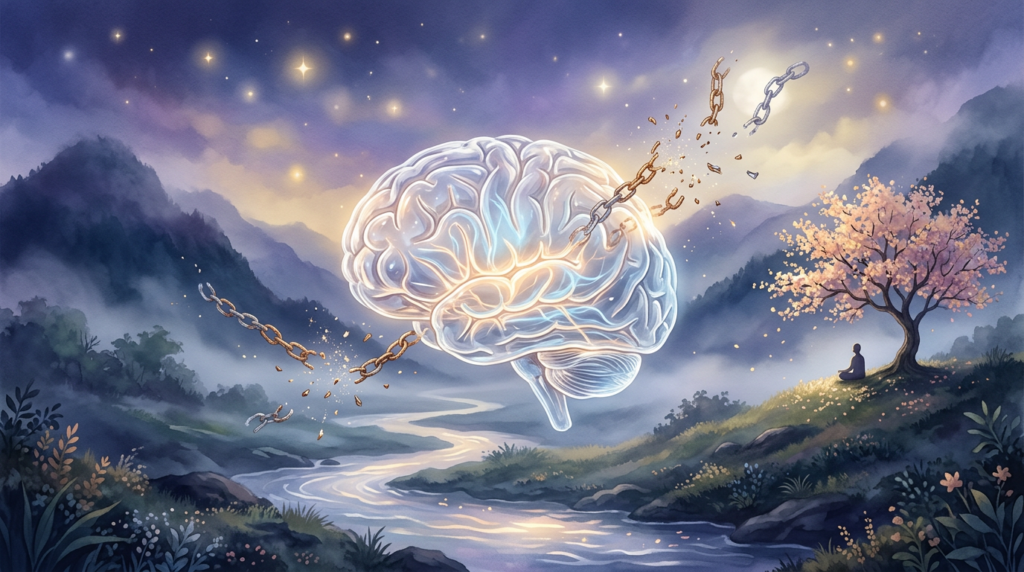
Our minds may well be the greatest prison we will ever know. Not because they physically confine us, but because they trap us in our own thoughts, beliefs, and fixations.
As a wise person once said: "It is perfectly possible for a man to be out of prison, and yet not free—to be under no physical constraint and yet to be a psychological captive." We move through the world, free in our actions, yet our minds can keep us captive in an endless loop of repeating patterns, fears, and attachments.
In Taoism and Buddhism, it is emphasized that true freedom comes through letting go. The Diamond Sutra teaches us that even the most sacred concepts, such as "Buddha" or "enlightenment," must be released to attain true wisdom. But how do we apply this in daily life? How do we recognize the walls we have built ourselves, and how can we tear them down?
The mind: Teacher and prison
The mind can be both our greatest teacher and our greatest obstacle. It forces us to observe ourselves, to recognize patterns in our thoughts, and to gain deeper insight into who we are. Yet, at the same time, it can trap us in a web of fixations. "The brain can be both your greatest teacher and your greatest obstacle."
Imagine standing in a room full of mirrors. Wherever you look, you see yourself. You can study every angle of yourself, but none of those mirrors will show you a way out. Doesn’t that feel like being stuck in our own thoughts? We analyze, reflect, and try to understand, yet we often remain trapped in the same patterns.
Fixations: The Invisible chains
Fixations are the invisible chains that keep us captive. They can be rigid beliefs, such as "I must be perfect—just look at social media, where everyone seems perfect" or "The world must be fair," or emotional attachments to people, memories, or material possessions. All these fixations limit us and keep us trapped in a cycle of emotional tension, jealousy, dissatisfaction, and so on.
In Buddhism, this is called the "Wheel of Life"—an endless cycle of desire, attachment, and suffering. In Taoism, the concept of wuwei (無為), or effortless action, is seen as the key to freedom. But how do we recognize these fixations in our own lives?
Letting go as the path to freedom
Letting go is not a one-time act but a continuous process. It begins with awareness: recognizing the thoughts and beliefs that hold you captive. Ask yourself: "Is this a fact, or an interpretation? What is actually happening now: am I a participant or an observer?" and "What would happen if I let this thought go?"
Often, one negative thought leads to more negative thoughts.
You might think: "Easy for you to say—you don’t know my problems." And that’s true, of course. But if you keep getting stuck in the same thoughts that create a spiral of negativity, does it really help to keep dwelling on them? Often, you suffer, but so do the people around you who start to worry.
Possible steps to release fixations
Awareness: Take the time to observe your thoughts. Write them down if it helps. What are the recurring themes?
Meditation: Spend a few minutes each day sitting quietly, letting your thoughts drift by like clouds in the sky. You don’t need to hold onto them.
Wuwei (無為): Act without forcing. Let things unfold as they will, without clinging to them.
Nature as a Mirror: Go for a walk, run, bike ride, or simply sit in nature and observe how everything is—without attaching to anything. This is hán dé (含德), the virtue of understanding the Tao (the ineffable, the unnameable—but more on that later).
Persoonlijke reflectie
I find my greatest freedom in nature: walking for hours in a forest or through the Broekpolder, far from the noise and distractions of the city. Walking isn’t just good for the body—it clears the mind, too. Wonderful, isn’t it?
By immersing myself in the Three Teachings and the Diamond Sutra, I’ve come to see the beauty in nature and all the small things around us—things we often overlook in the rush of daily life.
A new start?
Het brein hoeft geen gevangenis te zijn. Door bewust te worden van onze fixaties en ze stap voor stap los te laten, kunnen we de muren afbreken die we zelf hebben gebouwd. Ware vrijheid ligt niet in het ontvluchten van onze gedachten, maar in het leren leven met ze, zonder ons eraan vast te klampen. Het hoeft en gaat niet in één dag. Confucius zei ooit ¨Het doet er niet toe hoe langzaam je gaat, zolang je maar niet stopt.¨
Question for the reader
How could you let go of your own fixations, even if just for a moment? Share your experiences in the comments.
Sometimes you recognise someone instantly — while the other person feels nothing at all. What then?
In my earlier story, "The Invisible Thread of Yuanfen," I wrote about an encounter that felt mutual. But Yuanfen has another side.
Yuanfen can, in fact, carry different meanings. You recognise someone, but the other does not recognise you, or feels nothing. In that case there is Yǒu yuán wú fèn (有緣無分): the spiritual attraction to meet is there, but not a mutual destiny to be bound together.
Then you might start to doubt whether it is truly Yuanfen, or whether you are simply imagining it because someone is kind. You become attached to someone, but it seems one-sided. You do not receive what you, as a human being (on a relative level), wish to receive: attachment. It may also be that one person feels that attraction and the other does not. That can be frustrating at first for the one who does feel it.
In Buddhism, this is seen as a valuable lesson to free the mind from attachment. And according to the Diamond Sutra, it is clear as well: as a diamond cuts through everything, so this sutra cuts through all illusions — and in the end, Yuanfen too is an illusion.
Perhaps that is the consolation: one-sided recognition is not a failure, but a mirror. It shows where you yourself still cling — to recognition, to reciprocation, to the need to possess, to steer, or to protect. It is the same lesson as with your own growing children: to love without clinging.
Have you ever experienced an encounter where you thought: this is Yuanfen — but the other person did not feel it? Share your story in the comments. Let us discover together what one-sided recognition teaches us.
Sometimes you meet someone who feels as if you have known each other for ages. This is the story of such an encounter.
It was an ordinary day in May. My wife and I visited the Buddha hall where we gather to philosophise, to learn, to share a meal, and to pray.
I had already started studying the Three Teachings—Taoism, Confucianism, and Buddhism—and the Diamond Sutra. I thought I was already a little bit on my way to better understanding wisdom.
But on that day, while we were there, something extraordinary happened.
Unexplainable by words or logic.
There was a mysterious sense of recognition when we encountered a young man there. Not the recognition of a face, but perhaps of a soul. As if we had known each other already. I have no idea whether that feeling was mutual. He is the age of our children. How confusing can it be, as a parent, to feel as though he were your own child, without understanding how that is even possible? We did not speak much, because of the language barrier, yet every glance, every smile felt like a conversation that had already been going on for much longer. Like my wife and me, he is inspired by the deep wisdom of, among others, the Three Teachings, and that made the connection strong. My wife speaks Mandarin; she could translate everything. Before his journey back to Taiwan, we went out together a few more times, simply enjoying each other's company. Those moments have become unforgettable.
Because we read the scriptures together — among them the Three Teachings — but also simply laugh about everyday things, we have stayed in touch. It is special to make progress together in daily practice with such a young and wise fellow practitioner.
By the way, the name of this website and its logo are thanks to his name. His name means a powerful flight upward — a beautiful metaphor for soaring wisdom, for becoming a better person. And that is how soaringwisdom.nl came to be.
Yuanfen: The Invisible Bond
In Chinese, there is a beautiful word for this kind of encounter: Yuanfen (緣分). It describes the invisible thread that connects people. Not through pure chance, but through a deeper, inexplicable harmony. It is the idea that some people come into your life because your lives are interwoven. Not by birth, as with our three wonderful daughters, but through a kind of spiritual kinship.
This young man felt like one of those people. As if he were already part of our lives, and we were on the same wavelength. It was as if the universe had brought us together to learn from each other and to cultivate something that reaches beyond words.
It shows that age is, in the end, merely a number. The universe does not measure connection in years, but in the timeless harmony between souls.
From rationality to feeling
I have always been a rational person. Everything had to be explained with numbers, facts, and logic. That gradually lessened, but this encounter definitively taught me that some things do not need to be understood in order to be valuable. Sometimes it is enough to feel. To experience that there is more between heaven and earth than our reason can grasp.
The Three Teachings have further taught me that wisdom is found not only in books, but also in the silence between the words. In the glances you share, in the moments when you know: this is exactly where I am meant to be. You learn to appreciate the extraordinary in the ordinary things.
What Yuanfen has taught me
This encounter was a true turning point. Life is sometimes more beautiful when you allow yourself to be surprised. That not everything needs to be dissected or explained. Sometimes it is enough to know that there is a deeper connectedness, a thread that binds us all together, visible or invisible.
And perhaps that is the greatest lesson: that we are all part of something greater. That, whether we are physically connected or not, we can find each other on a level that reaches beyond words.
And that our mutual Yuanfen had an invisibly guided purpose? A few years ago, I probably would have said that such a thing doesn't exist. Now I say: it is impossible for this to be a coincidence.
Letting go
Finally, I would like to share something personal about this. If you have a family with children of your own, you know how deep and unconditional the love for them feels. When you then suddenly meet someone who awakens exactly that same intense parental feeling in you, it can be quite confusing. Your automatic reaction as a parent is to want to offer that same protection right away. But in a relationship between adults, or with a stranger, that protectiveness can quickly become suffocating and counterproductive.
It is precisely at that confusing point that the Diamond Sutra meets my experience. Such encounters are no coincidence; they bring a valuable lesson. That intense feeling of parental love with Yuanfen is absolutely allowed to be there, but just as with your own growing children, at some point you must also dare to let it go. You learn to release the need to possess, to steer, or to protect. And that is exactly what the Diamond Sutra tries to teach us: to love intensely, without clinging to it. I still struggle with it now and then. That makes it a little more human, too.
But what if that recognition exists on only one side? That is the topic of my follow-up post: When Yuanfen Is One-Sided .
Have you ever experienced such an encounter? Someone who made you feel as if you already knew each other, as if you were on the same wavelength? Share your story in the comments. Let us discover together what Yuanfen means to us.
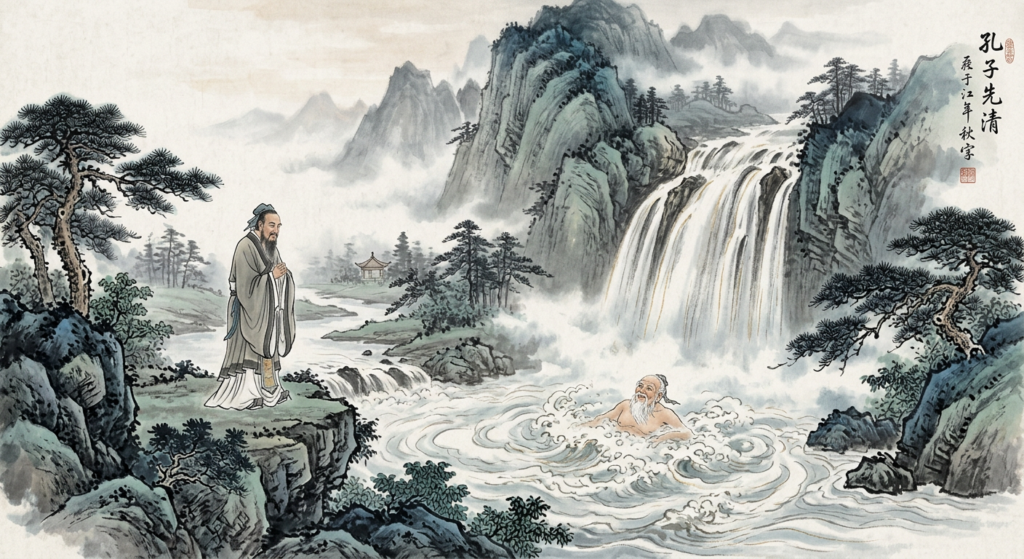
This is the story of Confucius and the swimmer at the Lüliang Waterfall..
Several waterfalls can be found throughout the Lüliang Mountains. A famous waterfall sharing this name (呂梁瀑布) plays a major role in classical Taoist stories, such as the Zhuangzi. Although historians suspect that the specific waterfall from the parable was actually located in a different region at the time, its symbolism is strongly associated with the rugged mountain landscape of Lüliang today. In the story, a swimmer survives the roaring torrent by completely adapting to the water. In doing so, the waterfall symbolizes the natural strength, flexibility, and harmony (wu wei) that are central to Taoism.
It is a story that makes you reflect on how we approach life. In this story, we see how natural harmony and spontaneity are the key to true wisdom.
Just like The Vinegar Tasters, this story explores three ways of looking at the world, but with a different perspective: the power of letting go and going with the flow.
The Story
One day, Confucius visited the Lüliang Waterfall, where the water cascaded down with tremendous force. The flow was so wild that even large water creatures could not swim in it. Suddenly, Confucius saw a man calmly moving in the water, as if he were taking a leisurely stroll. He thought the man was in distress and sent his disciples to rescue him.
But when the man emerged, he was singing and walking along the shore, as if nothing had happened. Confucius, amazed, asked: "How can you remain so calm while swimming in such turbulent waters? Do you have a special method?"
The man replied: "I follow no method. I began with my nature, grew with my character, and completed with my destiny. I go with the flow, just like the water itself."
The Lüliang waterfall
In ancient China, the Lüliang Waterfall was known for its unstoppable power. The water plunged thirty ren (about 200 meters) down and carried foam forty li (over 20 kilometers) away. For most people, it was impossible to swim there. But for the swimmer, it was as natural as walking on the ground.
Confucius: The Seeker of Method
Confucius looked at the swimmer and saw danger. To him, life was something that had to be understood and mastered through knowledge, rules, and effort.
"How can someone simply swim in that water?", he thought. "There must be a reason, a lesson we can learn."
For Confucius, life was like a book to be studied. He believed in responsibility, learning, and improving the world through action.
The Swimmer: The Master of the Flow
The swimmer smiled and said: "I do nothing special. I simply am. I was born on the hills and feel at home on the hills. I grew up in the water and feel at home in the water. I don’t know why I can do this—it just happens."
For the swimmer, life was like a river: you don’t need to fight the current; you only need to go with it. He teaches us to trust our natural selves and follow the way of the water.
The Lesson of Laozi (Implicitly Present)
Although Laozi does not appear in this story, you can feel his wisdom in the swimmer’s words. For Laozi, life is like water: soft yet unstoppable. It follows its own path without resistance. The swimmer lives this philosophy—he does not do, he simply is.
What can we learn from it?
De Zwemmer en de Weg van het Water
Persoon
Response
Reading for Us
Confucius
Seeks a method
Learn and work hard, but be aware of the limits of knowledge. limieten van kennis.
The Swimmer
Goes with the flow
Trust your natural self and let go of what you cannot control.
Laozi
Water as a metaphor
Be like water: flexible, adaptable, and in harmony with the Dao.
A Reflection
When looking at Confucius and the swimmer, you see two opposing yet complementary approaches. Confucius teaches us that knowledge and effort are important, but the swimmer shows that natural harmony is just as valuable. Perhaps the greatest wisdom is to embrace both lessons: learn and do what you can, but let go of what is beyond your control.
Just like The Vinegar Tasters, it’s about carrying different perspectives in your heart. Sometimes life is sour, sometimes sweet, and sometimes you just have to go with the flow.
I think the complementarity between the Teachings is fantastic!
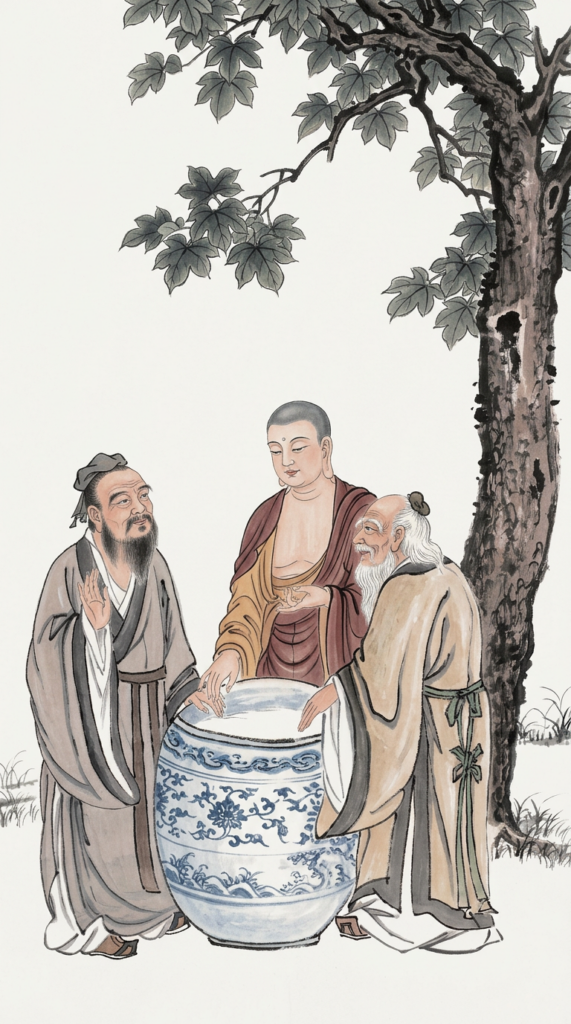
Do you know the story of the Vinegar Tasters? This tale beautifully illustrates how one can experience the world. In the image, there is a large vat of vinegar and the three great Sages of China: Confucius, Buddha, and Laozi.The vinegar in the vat is a metaphor for life itself. The way each of them reacts to the taste—sour, bitter, or sweet—reflects the core of their life philosophy.
The Story
On a sunny day in a small village in ancient China, three wise men stood by a large vat of vinegar. Each dipped a finger into the vat and tasted it. But what happened? They all responded differently! Dit is het verhaal van Confucius, Laozi and Buddha, and what we can learn from them.
The Vinegar Pot
In the heart of the village stood a large vat of vinegar. Vinegar is sour, and not everyone likes it. But on this day, three great teachers decided to taste it. They wanted to know: What does life actually taste like?
Confucius: The Teacher of Order
Confucius dipped his finger into the pot and tasted. He pulled a sour face.
“This is not good!”, he thought. “Het leven zou zoeter moeten zijn. We moeten harder werken om de wereld beter te maken.”
Voor Confucius was het leven als een les die we moeten leren. Hij gelooft in respect, good behavior, and following rules to create harmony.
Lao Tzu: The Sage of Nature
Laozi dipped his finger into the pot and tasted. He smiled.
“Life is as it is”, he thought. “Soms is het zuur, soms zoet. Maar als we meegaan met de stroom, zoals een rivier, dan is alles in balans.”
Voor Lao Zi is het leven als een boom die groeit zonder haast. Hij leert ons om let go and trust the natural way.
Buddha: The Enlightened One
Buddha dipped his finger into the pot and tasted. Although the taste of the vinegar was bitter — a symbol of the suffering inherent to earthly life — he did not judge. He remained completely calm and serene.
“The vinegar is just vinegar”, he thought. “Suffering only arises when we fight against how things are, or when we desire for the bitter to become sweet.”
For Buddha, life is a succession of experiences that we without judgment must observe to find inner peace.
What can we learn from it?
Wise
Response
Reading for Us
Confucius
Sour face
Be responsible. Work hard to make the world a better place.
Laozi
Smile
Accept life as it is. Trust the natural balance.
Buddha
Calm and neutral
Let go of what you cannot change. Find peace in the moment.
A Reflection
When you look at these three sages, you see that none of them are “wrong.” Confucius reminds us that we must actively contribute to a better world, Lao Zi teaches us to let go and trust the natural course of things, and Buddha shows us how to find freedom through non-judgment. Perhaps the greatest wisdom is to carry all three lessons in your heart: do what you can, let go of what you cannot change, and remain calm amidst it all. That is how I see it myself as well.
Niemand was het dit keer ontgaan. De zonsverduistering. Er was een ware run op die speciale zonnebrilletjes, onze dochter had ze online gescoord. De eerste zending was al een paar weken terug besteld, maar die kwam nooit aan. Bij een tweede bestelling waren ze alweer duurder!
Being together on the beach are also those wonderful moments when you can have a nice, relaxed chat with each other. We were able to enjoy the eclipse from start to finish. It was a mysterious twilight during the eclipse.
Did you know that in Asia, August 13 marks the official start of the Hungry Ghost Month? This signals the beginning of the seventh month of the Chinese lunar calendar. According to ancient traditions, the gates of the underworld swing wide open around midnight. Restless souls and hungry ghosts return to Earth to wander around. To keep them happy and appease them, people everywhere burn incense, leave food outside their doors, and burn special (joss) paper money.
But this year, the start of the seventh lunar month holds an extra deep, spiritual meaning for many. The night before, we were treated to a breathtaking spectacle in the sky: a deep solar eclipse, immediately followed by the magical Perseids meteor shower (shooting stars). The fact that these cosmic gates opened right after the sun was eclipsed and stars rained down from the sky makes this Ghost Month feel far more mystical and powerful than ever before to many.